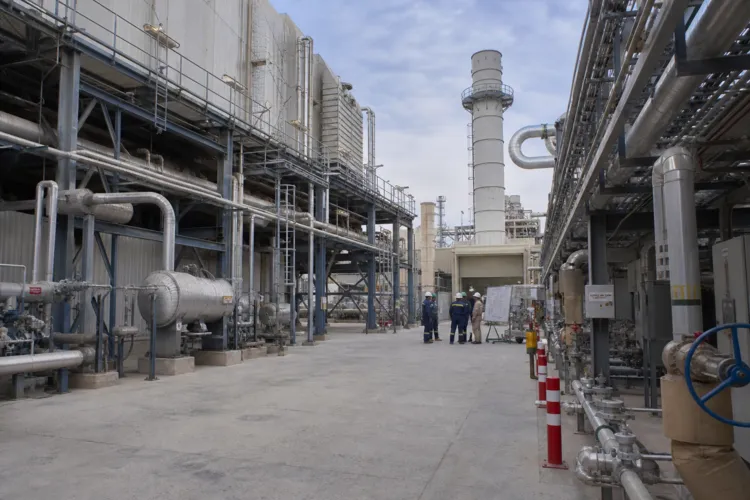

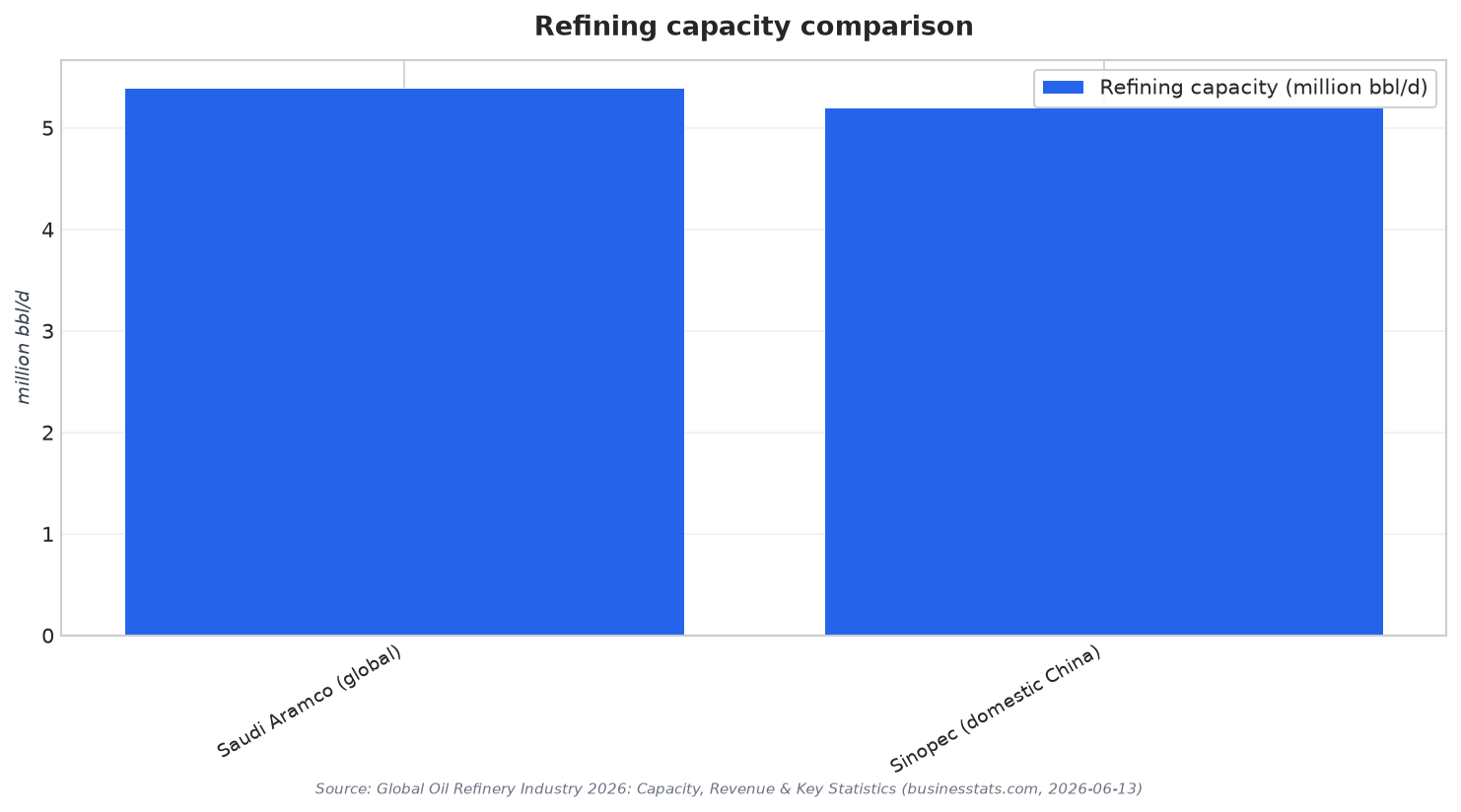
Saudi Aramco is pushing a chemicals-led downstream strategy that aims to extend the economic value of crude rather than reduce oil output. Multiple sources describe a clear pivot from fuels to chemicals as transportation fuel demand growth weakens over the long term. Aramco’s plan includes converting up to 4 million barrels of crude oil per day into petrochemical feedstock by 2030, a scale that signals how central petrochemicals are to its future value creation. The company also controls about 5.4 million bbl/d of refining capacity globally through wholly-owned sites and joint ventures, giving it a large platform to integrate refining and chemicals.
The underlying idea is simple. Traditional refineries typically turn only a small share of the barrel into chemicals. Aramco Europe describes “regular” chemical production per barrel at 8% to 12%, and notes that integrated complexes can be tweaked to raise this to as much as 50%. In parallel, industry descriptions of new crude oil to chemicals complexes in Saudi Arabia, China, and India put typical designs at 40% to 50% conversion of crude directly into petrochemical products, compared with 10% to 15% in conventional configurations. That difference is why crude-to-chemicals is framed as a structural shift, not a marginal upgrade.
From Refining to Integrated Chemical Yield: The SABIC and TC2C Angle
Aramco’s approach blends portfolio moves with technology development. A centerpiece is SABIC integration. One analysis notes that Aramco acquired a 70% stake in SABIC for $69 billion in 2020, positioning chemicals as a core pillar “beyond oil” while keeping hydrocarbons central. On the technology side, Aramco and SABIC describe targeting 70% to 80% of each barrel converted to chemicals “in a competitive manner.” Market research also points to Aramco’s proprietary thermal crude to chemicals (TC2C) technology, developed with Chevron Lummus Global, demonstrating crude-to-chemicals yields exceeding 70% in pilot-scale operations as of late 2025.
Economics and competitive positioning are also part of the story. One market report says purpose-built crude-to-chemicals complexes can raise crude-to-chemicals conversion to 40% to 70% and cites margins of $60 to $80 per barrel of crude processed for fully integrated COTC operators, compared with $15 to $25 per barrel for fuel-focused refineries. Aramco’s scale supports this integration push. Another source estimates Aramco’s market capitalization at $1.8 trillion and states its downstream refining and petrochemical operations contribute about 25% of total corporate value. This reinforces why Aramco is treating chemicals as a value lever, not a side business.
In Saudi Arabia, this strategy is described as expanding the range of chemical derivatives produced domestically and strengthening the country’s role as a petrochemical hub. The Saudi petrochemicals landscape includes large integrated producers such as SABIC, Saudi Aramco, Sadara Chemical Company, Petro Rabigh, Tasnee, Sipchem, Advanced Petrochemical Company, Sahara International Petrochemical Company, Saudi Kayan Petrochemical Company, and Yansab. Still, the sector faces cyclical volatility because petrochemical prices remain closely linked to global crude oil markets, and periods of weak demand or oversupply can pressure margins. That context is why crude to chemicals in Saudi Arabia is positioned as an integration and yield strategy aimed at extracting more value per barrel across cycles.
What is Aramco targeting with its crude-to-chemicals strategy by 2030?
How much of a barrel can crude-to-chemicals convert into petrochemicals?
How does SABIC fit into Aramco’s chemicals push?
Why does crude-to-chemicals matter for the topic of crude to chemicals in Saudi Arabia?
Talk to us for your needs in:
-
Energy Efficiency Strategy & Feasibility
-
Renewable Energy Strategy & Investment Advisory
-
Digital Energy & Smart Grid Strategy
-
Market Entry Strategy
-
Sustainability & Impact Strategy
-
Energy Project Governance & PMO Advisory
-
Energy Market Research
-
Energy Stakeholder & Customer Research
-
Energy Market Intelligence
-
Energy Feasibility & Investment Assessment
-
Energy Sector Benchmarking & Performance Strategy