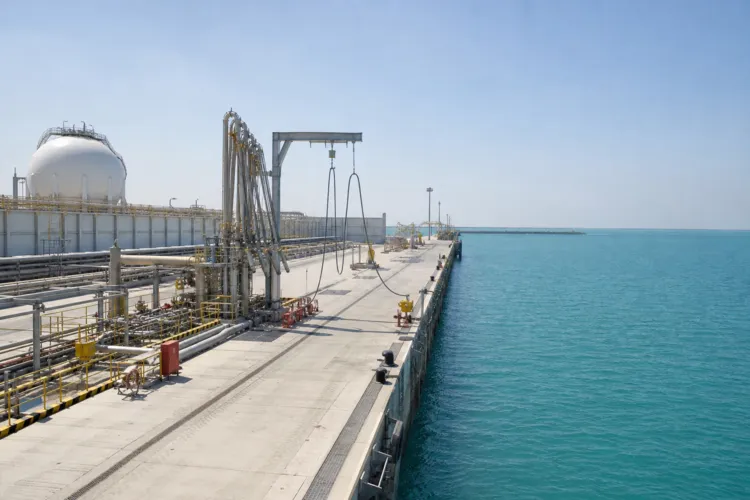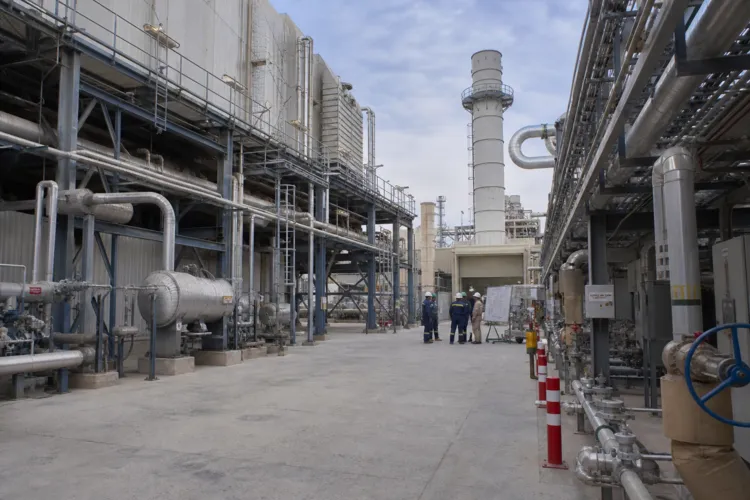
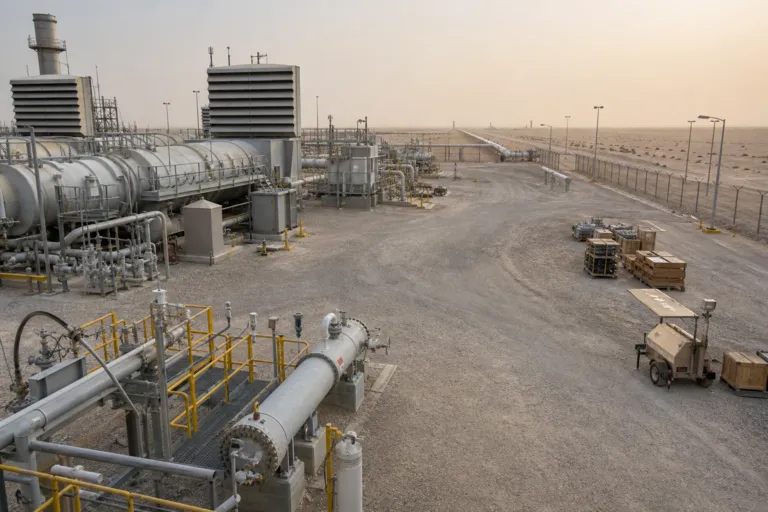
Saudi Aramco’s Master Gas System Expansion Phase 3 (MGS-3) is positioned as one of the largest oil and gas pipeline projects in Saudi Arabia. The program is described as a brownfield expansion in the Eastern Province, designed to enhance the Kingdom’s non-associated gas, unconventional gas, and related condensate reserves by strengthening the gas transport backbone. The Master Gas System (MGS) itself dates back to the mid-1970s and has been operational since 1982, with early design focused on moving associated gas from the Ghawar field to industrial hubs and reducing flaring. This third expansion continues the multi-phase approach used to bring additional gas resources into the national network.
Across sources, the scale of the build is consistently framed in terms of extensive new pipeline mileage and added transport capability. One project profile states a total pipeline length of 4,153 km for MGS-3. Argus reports the third-phase expansion will install 4,000 km of pipelines and add 17 new gas compression trains. A separate Saudi midstream market outlook characterizes Master Gas System Phase 3 as adding 3,000 km of domestic capacity, describing it as a way to relieve existing pipelines that are running at 85% utilization. Taken together, the reporting points to a substantial expansion of Saudi Arabia’s gas transmission grid and compression support infrastructure through this phase.
What MGS-3 Adds: Pipelines, Compression, Contracts, and Timelines
Execution details also underline how the build is being packaged and delivered. One project profile says construction commenced in the second quarter of 2024 and is scheduled for completion by the fourth quarter of 2028, with delivery through 17 EPC work packages. The same source states the project includes upgrading existing gas compression systems and installing new compressors, and it notes that Aramco awarded 15 lump sum turnkey contracts worth a combined USD 8.8 billion. Another market report referencing Reuters also cites Saudi Aramco’s USD 8.8 billion Master Gas System Phase 3, describing it as a mega-project that adds thousands of kilometers of gathering and transmission lines and supports long-term service demand such as hydrostatic testing and intelligent pigging.
Capacity goals are presented with different baselines and endpoints depending on the source, so it is important to keep each statement tied to its original context. One project profile says MGS-3 will expand the system’s capacity to an additional 3.2 billion standard cubic feet per day, and it also describes increasing network capacity to 15.7 billion standard cubic feet of gas per day. Argus, in a separate statement, says the third phase will raise capacity by 3.15 billion ft³/d to 12.5 billion ft³/d by 2028, alongside the 4,000 km of pipelines and 17 compression trains. For context on prior expansion, the same project profile says MGS-2 EPC works were completed in 2021, increasing capacity from 8.4 billion cubic feet a day to 12.5 billion cf/d.
In the broader midstream setting, forecasts place pipelines at the center of Saudi Arabia’s transport and logistics buildout. Verified Market Research values the Saudi Arabia oil and gas midstream market at USD 82.50 billion in 2024 and projects USD 121.36 billion by 2032, with 5.1% CAGR from 2026 to 2032. A separate midstream outlook notes pipelines delivered 57.20% of 2025 revenue and are poised for a 6.48% CAGR, explicitly linking that momentum to new lines under Master Gas System Phase 3. For procurement and materials context, Mordor Intelligence reports Saudi Arabia was the largest market in the Middle-East oil and gas line pipe market with 39.36% demand in 2025, where welded pipe held 63.15% share and transmission accounted for 57.44%.
What is Aramco’s Master Gas System Expansion Phase 3 (MGS-3)?
How many kilometers of pipelines are associated with MGS-3 in Saudi Arabia?
What is the timeline for Master Gas System Phase 3?
How much investment is cited for the Phase 3 contracts?
How is the master gas system in Saudi Arabia linked to midstream growth?
Talk to us for your needs in:
-
Energy Efficiency Strategy & Feasibility
-
Renewable Energy Strategy & Investment Advisory
-
Digital Energy & Smart Grid Strategy
-
Market Entry Strategy
-
Sustainability & Impact Strategy
-
Energy Project Governance & PMO Advisory
-
Energy Market Research
-
Energy Stakeholder & Customer Research
-
Energy Market Intelligence
-
Energy Feasibility & Investment Assessment
-
Energy Sector Benchmarking & Performance Strategy