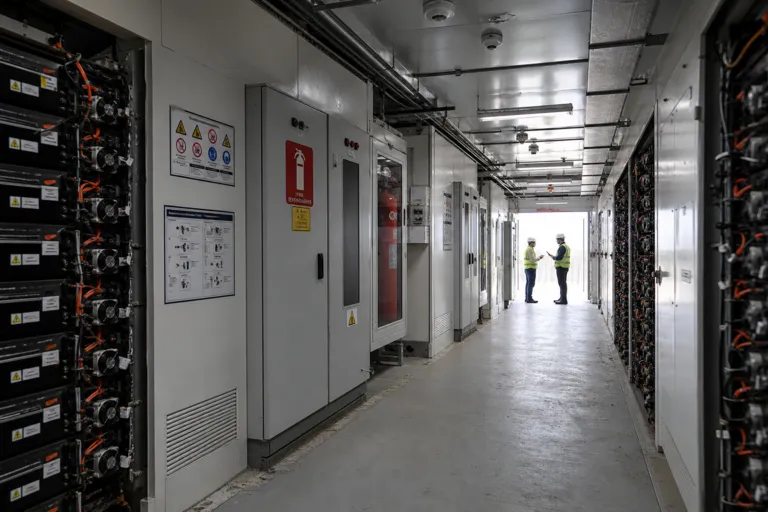
Battery energy storage is moving from pilot scale to mainstream deployment across Saudi Arabia’s energy transition, including mega-projects such as NEOM and the Red Sea Global destination, where BESS supports grid stability. With that scale comes tighter scrutiny of safety engineering and documentation. Saudi Electricity Company (SEC) Battery Energy Storage System Connection Guidelines add local performance and safety requirements, including reliable operation in 50°C high-temperature, high-dust environments and gas detection interlocked with explosion-proof ventilation. In parallel, Saudi projects often reference international standards in permitting and submittals, including NFPA 855 and IEC 60079, while the Saudi Building Code and local fire authority regulations add requirements for placement, spacing, and suppression integration.
Risk planning starts with a realistic view of failure modes. Research cited in the international journal Energy notes that flammable gases generated from lithium-ion battery thermal runaway can accumulate rapidly within energy storage stations and may lead to severe explosions when exposed to an ignition source. The same source reports that between 2011 and 2021, 32 energy storage fire and explosion incidents were reported worldwide, which is useful context for hazard identification but not Saudi-specific incident frequency. For Saudi designs, the practical implication is to treat vented-gas management, ignition control, and compartmentalization as first-order design inputs, not add-ons late in construction.
Codes and Certifications Shaping Saudi BESS Fire Safety
Saudi requirements combine local grid-connection rules with internationally recognized testing and certification pathways. SEC’s process requires Saudi IECEE certification based on IEC 62619 and submission of compliance documentation during grid connection. For grid-connected projects, UL 9540 certification is described as increasingly mandatory, driving enclosure design requirements for fire safety, venting, and thermal runaway containment. Utility-scale projects also face tender and specification pressure around fire testing and system-level validation: UL 9540A large-scale fire test compliance is moving from a differentiator to a baseline requirement in Saudi tender documents, and UL 9540A and IEC 62933 are described as mandatory for utility-scale BESS projects in Saudi Arabia. Designers should also reflect environmental protection expectations, since NEMA and IP rating standards are cited for dictating environmental protection levels in harsh site conditions.
Design best practices in the Kingdom are increasingly tied to execution realities: imported certified hardware lead times, integration complexity, and approval coordination. Saudi Arabia is described as a pure import market for high-specification fire suppression components, with supply lead times of six to twelve months for imported, certified hardware and chemical agents creating a bottleneck for fast-tracked projects. Market guidance also highlights a shift from conventional sprinkler-based designs toward clean agent and water mist systems engineered to control lithium-ion thermal runaway propagation, along with deeper integration of protection logic into BMS and EMS layers for faster detection of venting events and targeted agent release. For best outcomes, engage early with Saudi Civil Defence and SEC on explosion-proof expectations, and explicitly cite NFPA 855, IEC 60079, and SEC guidelines in project documentation to reduce approval delays.
Broader market momentum makes consistent compliance even more important. One forecast projects Saudi Arabia’s behind-the-meter stationary battery storage market at an estimated USD 180–250 million in 2026, rising to over USD 1.2–1.8 billion by 2035, with commercial and industrial applications accounting for more than 55% of deployed capacity through the forecast period and solar-plus-storage representing over 60% of new behind-the-meter systems. Another projection ties fire protection demand to cumulative installed storage capacity surpassing 26 GWh by 2035. In this context, “BESS fire safety” in Saudi Arabia becomes a bankability issue as much as a technical one: specify certified enclosures, plan for gas detection and explosion-proof ventilation where required, and build a documentation package that matches SEC and local authority review workflows.
What standards are commonly referenced for BESS fire safety in Saudi Arabia?
Why do Saudi BESS projects emphasize explosion-proof ventilation and gas detection?
What certifications are becoming baseline requirements in Saudi tenders?
How do desert conditions change battery storage fire safety design in Saudi Arabia?
How should teams manage approvals for BESS fire safety in Saudi Arabia?
Talk to us for your needs in:
-
Energy Efficiency Strategy & Feasibility
-
Renewable Energy Strategy & Investment Advisory
-
Digital Energy & Smart Grid Strategy
-
Market Entry Strategy
-
Sustainability & Impact Strategy
-
Energy Project Governance & PMO Advisory
-
Energy Market Research
-
Energy Stakeholder & Customer Research
-
Energy Market Intelligence
-
Energy Feasibility & Investment Assessment
-
Energy Sector Benchmarking & Performance Strategy