The Saudi energy sector still relies on oil and gas, which contributed 28.2% of GDP in 2021, but it is opening new opportunities in renewables, localization and energy efficiency. For international suppliers, success depends on supporting Saudi Aramco's localization goals, joining renewable projects, and adapting to rising energy costs from tariff reforms.
Eurogroup Consulting's The CEO Guide to KSA: Saudi Arabia Reimagined, Are You Ready? examines how Saudi Arabia's Vision 2030 strategy influences the country's traditional energy industry and emerging investment areas.
While hydrocarbons remain economically important, the Kingdom's energy development agenda also creates opportunities for technology providers, investors, and specialist contractors capable of supporting a more diversified energy system.
How Important Is Oil and Gas to the Saudi Energy Sector Today?
Oil and gas have historically underpinned Saudi Arabia's economic development and international commercial relationships. According to the CEO Guide, the hydrocarbon sector contributed approximately 28.2% of Saudi Arabia's gross domestic product in 2021. This historical contribution demonstrates the industry's importance despite the Kingdom's efforts to diversify economic activity.
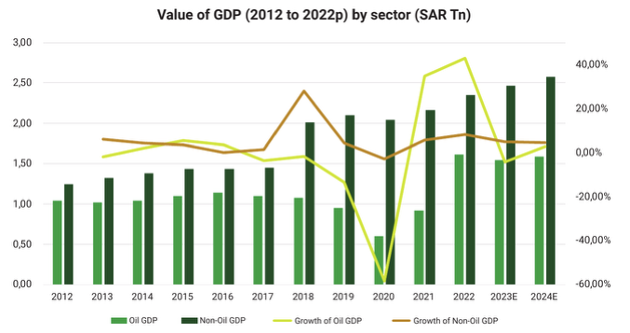
Figure 1: Value of GDP by Sector, Oil vs. Non-Oil (SAR Tn). Source: The CEO Guide to KSA, Eurogroup Consulting (p. 15).
Saudi Aramco remains central to the country's energy ecosystem, generating demand for engineering, equipment, maintenance, technology, and specialist industrial services. The guide records Aramco's announced intention to allocate US$35–40 billion annually in capital expenditure through 2025, including capacity expansion and sustainability-related activities. As that planning period has passed, this figure should be understood as a historical investment announcement rather than a current expenditure forecast.
The wider supply chain extends beyond upstream production into refining, petrochemicals, industrial manufacturing, and energy infrastructure. Europe also remains an important destination for Saudi oil and petroleum products, as reflected in the guide's trade analysis.
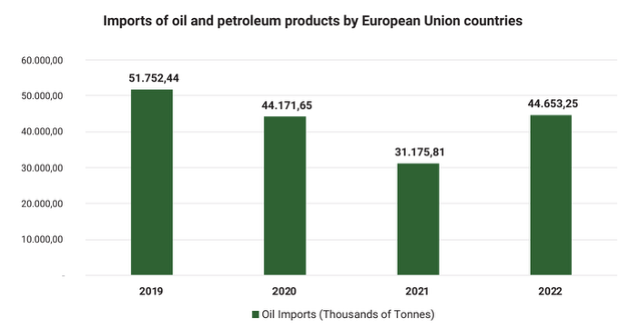
Figure 2: Imports of Oil and Petroleum Products by European Union Countries (Thousands of Tonnes). Source: The CEO Guide to KSA, Eurogroup Consulting (p. 47).
International suppliers can participate in these activities, but technical capabilities alone may not determine competitiveness. Procurement conditions, operational reliability, local partnerships, and compliance requirements can influence market access. As Saudi Arabia advances industrial diversification, companies must increasingly consider how their offerings contribute to domestic economic development alongside energy-sector performance.
What Is IKTVA, and Why Does It Matter for Suppliers?
Saudi Aramco's In-Kingdom Total Value Added (IKTVA) program encourages suppliers to increase their contribution to the domestic economy through local manufacturing, employment, services, and capability development. For international firms, this may influence decisions concerning production facilities, technology transfer, partnerships, and workforce development.
Localization does not necessarily require every supplier to establish a wholly owned manufacturing operation. Companies may evaluate partnerships with local manufacturers, service arrangements, joint ventures, or investments in domestic operations. However, such decisions affect costs, management responsibilities, and long-term strategic flexibility.
Read more about the evolving procurement environment in Local Content Requirements in Saudi Energy Projects: A Practical Path to the 2030 Threshold.
The underlying business challenge is to develop a localization approach that creates measurable operational value rather than merely satisfying an administrative requirement. Companies need to understand whether local investment improves responsiveness, strengthens supply-chain resilience, or supports access to relevant customers.
How Is Saudi Arabia Growing Renewable Energy?
The Renewable Energy Project Development Office (REPDO) is among the institutions highlighted in Eurogroup Consulting's guide for facilitating renewable project development.
The guide identifies Sakaka Solar Photovoltaic Independent Power Producer as Saudi Arabia's first utility-scale renewable energy project, developed through a public-private partnership structure with an investment of approximately US$320 million. The project illustrates how private-sector capabilities can contribute to national electricity-development priorities.
Saudi Arabia has also used financing support to encourage investment in renewable technologies. The guide describes a Saudi Industrial Development Fund (SIDF) financing initiative offering renewable energy loans of up to US$267 million, subject to the program's applicable requirements. King Salman Energy Park (SPARK) represents another industrial development initiative, intended to support energy-related manufacturing and services.
Renewable projects can create opportunities for developers, engineering contractors, equipment manufacturers, and technology providers. However, financial feasibility depends on procurement arrangements, technical requirements, available infrastructure, and project-specific financing.
What Do Energy Price Reforms Mean for Businesses?
The CEO Guide discusses electricity tariff reforms and gradual fuel subsidy adjustments designed to encourage more efficient resource use. For energy-intensive manufacturers and transport operators, changes in tariffs and fuel prices can affect operating expenditure and investment decisions. Companies may respond by reviewing equipment efficiency, consumption patterns, energy management, and alternative supply arrangements.
This creates potential demand for monitoring systems, efficient machinery, engineering services, and energy optimization technologies. The guide also highlights the importance of industrial research and development support through institutions such as King Abdulaziz City for Science and Technology.
As Guillaume Rebiere of the Saudi French Business Council observes in the guide:
"There are some historically strong sectors that characterize the commercial and business relationships related to French business activity in KSA and vice versa such as defence, aviation, infrastructure, and energy."
His observation illustrates the established international relationships supporting energy development.
For new entrants, commercial opportunities depend on demonstrating technical performance, understanding procurement requirements, and selecting an appropriate local operating structure. The strongest market positioning connects international expertise with Saudi Arabia's industrial and operational priorities.
For tailored support, explore our energy market entry strategy or contact our team to discuss your requirements.
Frequently Asked Questions
What are the main opportunities in the Saudi energy sector?
Opportunities include oil and gas engineering, maintenance services, industrial equipment, renewable power development, energy efficiency and technology solutions. Saudi Arabia's diversification strategy also encourages investment in clean energy and domestic industrial capabilities. However, according to the CEO Guide to KSA, success depends on procurement requirements, localization expectations, financing conditions and individual project priorities.
What is Saudi Aramco's IKTVA program?
In-Kingdom Total Value Added (IKTVA) is Saudi Aramco's supplier-development program. It encourages suppliers to increase their contribution to the Saudi economy through local manufacturing, services, employment and capability development. For international firms, IKTVA performance can influence procurement eligibility, so localization plans, partnerships and potential in-Kingdom investment should be assessed early in the bidding process.
What was Saudi Arabia's first utility-scale renewable energy project?
The Sakaka Solar Photovoltaic Independent Power Producer is identified in the CEO Guide as Saudi Arabia's first utility-scale renewable energy project. It is a solar park of approximately US$320 million developed through the Renewable Energy Project Development Office (REPDO) under a public-private partnership structure, showing how private developers can contribute to national renewable targets.
Does Saudi Arabia support renewable energy investment?
Yes. According to the CEO Guide, the Renewable Energy Project Development Office (REPDO) offers incentives and support for solar and wind projects, while the Saudi Industrial Development Fund (SIDF) has offered renewable energy loans of up to US$267 million. King Abdulaziz City for Science and Technology (KACST) also supports research and development in the sector.
Are energy costs rising for businesses in Saudi Arabia?
Electricity tariff reforms and the gradual reduction of fuel subsidies, described in the CEO Guide, are raising operating costs for energy-intensive businesses such as manufacturers and transport operators. Large industrial users may face higher tariffs during peak hours. This makes investments in efficient equipment, energy management and optimization technologies more commercially attractive.
Explore Saudi Arabia's Energy Investment Landscape
Eurogroup Consulting's CEO Guide provides further perspectives on the Kingdom's energy sector, regulatory environment, localization requirements, and international expansion strategies.
Talk to us for your needs in:
-
Energy Efficiency Strategy & Feasibility
-
Renewable Energy Strategy & Investment Advisory
-
Digital Energy & Smart Grid Strategy
-
Market Entry Strategy
-
Sustainability & Impact Strategy
-
Energy Project Governance & PMO Advisory
-
Energy Market Research
-
Energy Stakeholder & Customer Research
-
Energy Market Intelligence
-
Energy Feasibility & Investment Assessment
-
Energy Sector Benchmarking & Performance Strategy