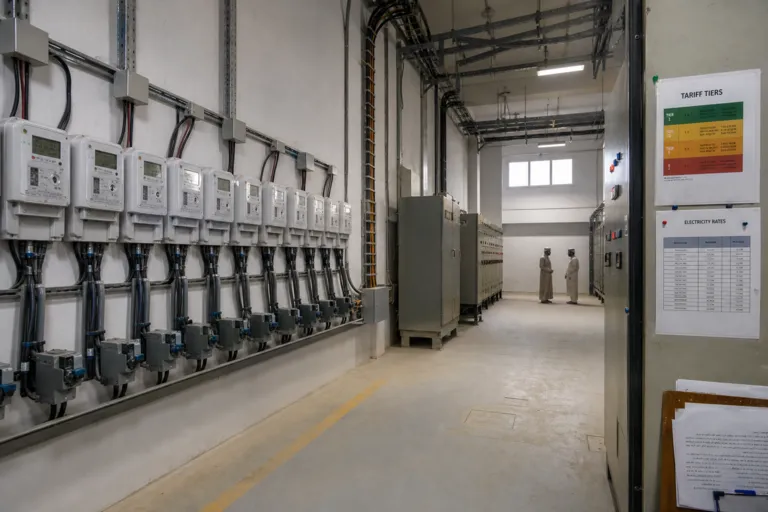
Understanding a commercial electricity tariff in Saudi Arabia starts with one simple point: the Kingdom does not bill power at a single flat price. Tariffs differ by consumer category, including residential, commercial, governmental, and agricultural, and some categories use tiered brackets where consumption is split across price bands. A tariff comparison tool that applies bracket rates shows why the same monthly kilowatt-hours can produce different totals depending on the sector, and it notes that results are planning estimates rather than official bills. In practice, official charges are set by the electricity provider and may include service fees or adjustments, so businesses should use calculators to budget, then verify against their statements.
For businesses planning for 2025 changes, one published figure highlights the risk of higher bills at higher usage. A Saudi-focused advisory on tariff changes states that, especially for businesses using more than 6,000 kWh per month, higher electricity tariffs of SAR 0.32 per kWh significantly raise operational costs, with a shift starting May 28, 2025. It also describes a real example where a Saudi manufacturing client faced a 25% jump in energy bills under the new structure. For context on how category rules can differ, a separate SEC calculator page explains that residential customers follow a two-tier rate revised in 2018 (SAR 0.18 per kWh for the first 6,000 kWh and SAR 0.30 above), and it explicitly notes that commercial customers pay separate tariffs not covered there.
How Businesses Cut Electricity Costs Under Tiered and Eligibility-Based Tariffs
Cost cutting starts with knowing what drives your bill and whether your facility fits special tariff eligibility. The Saudi Electricity Regulatory Authority (SERA) describes a “High intensity electricity consumption tariff” applied to eligible activities or sectors within industrial, commercial, and agricultural categories, based on the ratio of electricity cost to operational costs (excluding raw material costs). SERA states that second-cluster facilities can qualify when that ratio is between 10% and 19.9%, while first-cluster facilities can qualify when the ratio is 20% or more, subject to meeting requirements. Separately, efficiency retrofits are positioned as fast payback actions: one market analysis notes energy-service companies retrofit commercial towers with variable-speed drives and smart controls that cut cooling consumption by 20%, and those savings deliver payback periods under four years under newer tariff regimes.
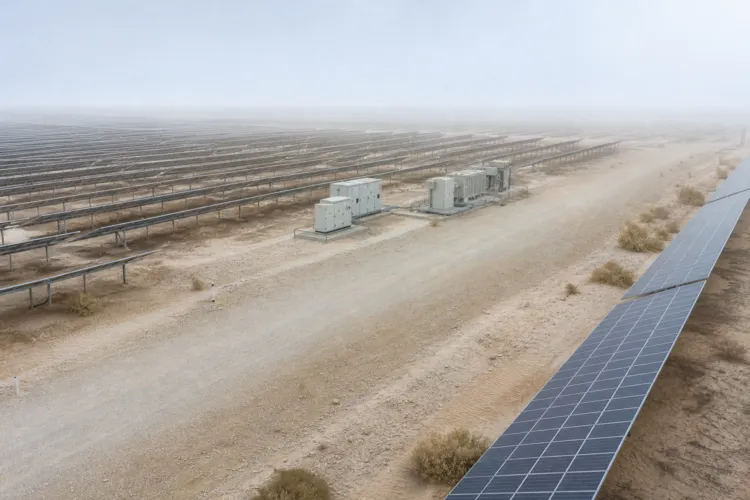
Onsite solar is frequently presented as a hedge against higher per-kWh charges, especially when generation aligns with daytime demand. The tariff-change advisory states that with SAR 0.32/kWh for high-use sites, solar PV can pay back in 3–5 years because solar generation can match peak use and directly offset higher tariffs. The same source emphasizes “every kWh saved is money kept,” and points to practical steps such as upgrading to LED lighting, optimizing HVAC, installing sensors, and using building automation to cut waste. Wider market trends support why more organizations are evaluating these moves: one Saudi power market analysis reports that utilities held 59.5% of the Saudi Arabian power market share in 2024, while tariff reforms are expected to encourage self-generation among large consumers.
Businesses should also plan for demand growth and manage load profiles, because rising commercial and industrial consumption increases the stakes of tariff design. The same market analysis states that commercial and industrial electricity consumption is rising at an 11.5% CAGR between 2025 and 2030, and it describes growing interest in software-based load management that flattens peak curves and reduces demand penalties on utility bills. For organizations that need ongoing market awareness, an energy-prices publisher notes that its Saudi Arabia electricity price data is updated monthly, on the 3rd business day of each month, with recent data updated on August 6th, 2026. Combined, these signals suggest a practical approach: confirm your applicable category and bracket rules, then prioritize measures that reduce kWh, smooth peaks, and offset daytime loads with onsite generation where viable.
How do commercial electricity tariffs work in Saudi Arabia?
What does the 2025 change mean for higher-usage businesses?
Can a business qualify for a high-intensity electricity consumption tariff?
What efficiency steps cut bills fastest under the new tariff regimes?
How can solar PV help reduce exposure to Saudi business electricity tariffs?
Talk to us for your needs in:
-
Energy Efficiency Strategy & Feasibility
-
Renewable Energy Strategy & Investment Advisory
-
Digital Energy & Smart Grid Strategy
-
Market Entry Strategy
-
Sustainability & Impact Strategy
-
Energy Project Governance & PMO Advisory
-
Energy Market Research
-
Energy Stakeholder & Customer Research
-
Energy Market Intelligence
-
Energy Feasibility & Investment Assessment
-
Energy Sector Benchmarking & Performance Strategy