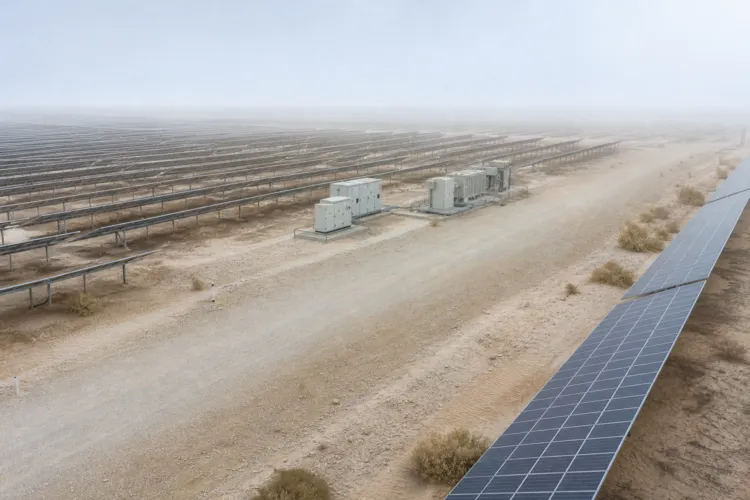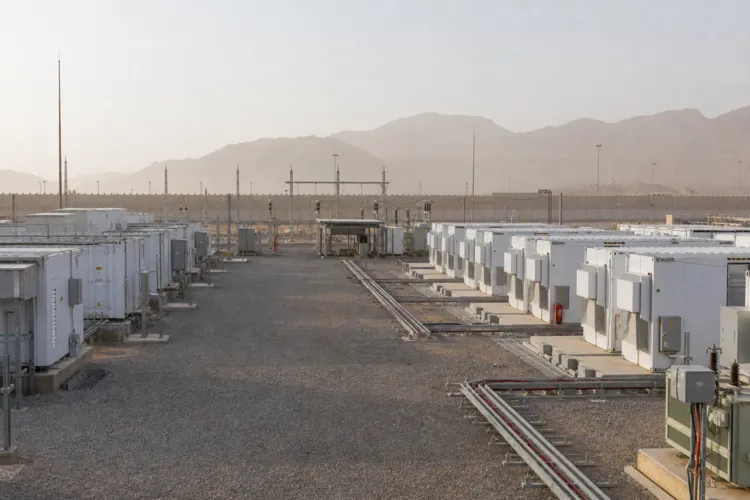
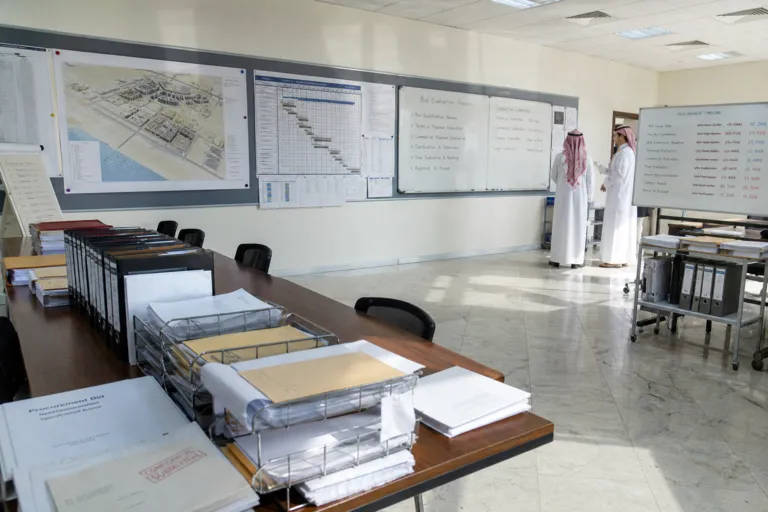
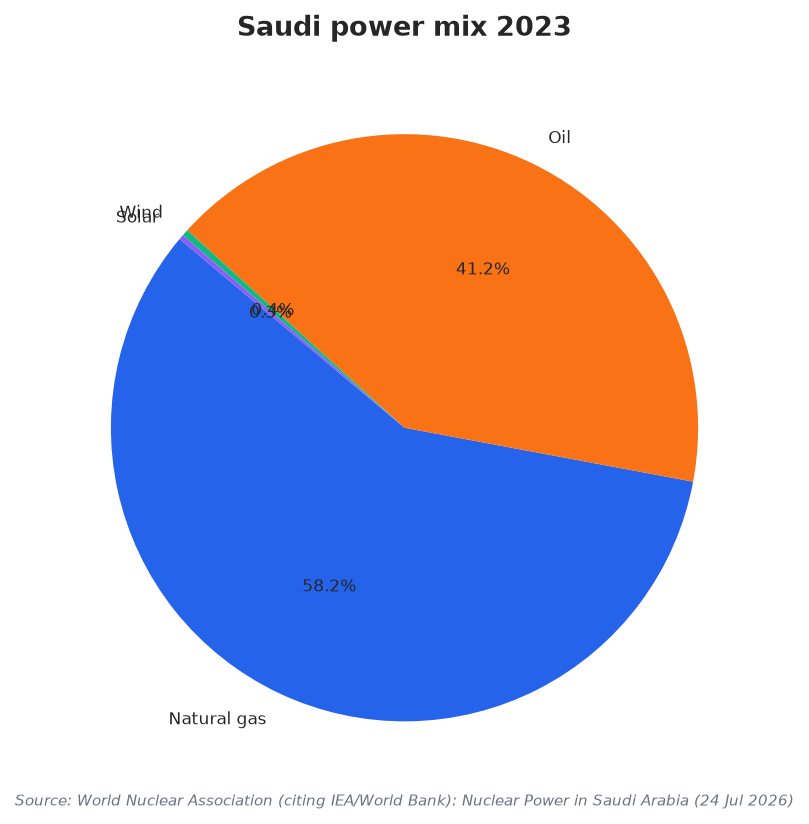
Saudi Arabia’s Duwaiheen project sits at the center of a wider effort to establish a civil nuclear power industry. The Duwaiheen site is described as licensed and empty, while procurement for the plant has been underway since 2022 with deadlines that have repeatedly slipped. The project has been framed as two reactors of roughly 1.4 GWe each. In parallel, Saudi Arabia’s electricity system remains dominated by fossil fuels: in 2023 total generation was 441 TWh, with natural gas at 257 TWh (58%) and oil at 182 TWh (41%), while wind was 1.6 TWh and solar 1.2 TWh. Against that backdrop, the Duwaiheen timeline matters because it tests whether procurement can move from paperwork to construction.
The approved bidder picture has also been consistent across accounts. Chinese, French, South Korean, and Russian bidders have been approved to compete. Industry descriptions also identify prospective suppliers as Westinghouse (US), Rosatom (Russia), an EDF-led grouping (France), KEPCO (South Korea), and CNNC (China), while noting the tender process has been extended multiple times and final offers were reportedly sought for a facility of roughly 2.8 gigawatts. A key practical constraint has been that American firms could not bid without a Section 123 agreement in force. That linkage helps explain why observers have expected Saudi Arabia to delay selection until after a US-Saudi nuclear cooperation agreement was signed, and why the tender’s shifting bid deadline has become a signal of strategic alignment as much as a commercial schedule.
Deadlines, Congress, and the Post-Signature Waiting Game
Deadlines have moved repeatedly. The tender for two Duwaiheen plants was launched in 2022 and was initially slated for bids in April 2024, but the deadline shifted again and still remained pending in late 2025 reporting. In July 2026, the US and Saudi Arabia signed a peaceful nuclear cooperation agreement under Section 123 of the Atomic Energy Act, alongside a separate bilateral safeguards arrangement. The US Department of Energy described the package as a legal foundation for a decades-long, multi-billion-dollar partnership and said the agreement would be transmitted to Congress for review. However, reporting also emphasizes that the agreement text remained unpublished as of late July 2026, meaning the operational details that could shape vendor participation and project timing are still not publicly confirmed.
Political messaging after signature created additional uncertainty about what comes next. Two days after the July 22, 2026 signing, President Donald Trump said he would not proceed unless Saudi Arabia joined the Abraham Accords and normalized relations with Israel, and he also stated Saudi Arabia would not be permitted to enrich nuclear material—conditions not presented as part of the signing announcement. Separately, analysis notes that since Fiscal Year 2020, successive US appropriations bills have conditioned Export-Import Bank support for nuclear exports on Riyadh concluding a 123 agreement that renounces enrichment and reprocessing and implements the Additional Protocol. For the Duwaiheen procurement, the practical takeaway is sequencing: transmission to Congress starts the clock, and the tender’s next deadline will be a concrete test of whether the new legal framework accelerates decisions or simply resets them.
What comes after the 123 deal is therefore likely to be measured in process milestones rather than instant project awards. The Department of Energy announcement confirmed signature and congressional transmission, but stated no duration and no enrichment terms. Meanwhile, Saudi governance signals point to consolidation: the National Atomic Energy Project is overseen by the Ministry of Energy alongside King Abdullah City for Atomic and Renewable Energy, and the Duwaiheen procurement is explicitly called out as a key test of whether the consolidated office can move from extended deadlines to a firm bid cut-off. For readers tracking the duwaiheen nuclear power plant tender, the most defensible markers are the approved bidder set, the roughly 1.4 GWe-per-unit framing, and the fact that the US pathway depends on an agreement whose text and review trajectory remain central to the next step.
Who has been approved to bid for the Duwaiheen project?
What capacity is associated with the Duwaiheen plant in the sources?
What happened to the bid deadline for the Duwaiheen procurement?
How does the US-Saudi Section 123 agreement relate to the Duwaiheen tender?
What does Saudi Arabia’s current electricity mix look like in the sources?
Talk to us for your needs in:
-
Energy Efficiency Strategy & Feasibility
-
Renewable Energy Strategy & Investment Advisory
-
Digital Energy & Smart Grid Strategy
-
Market Entry Strategy
-
Sustainability & Impact Strategy
-
Energy Project Governance & PMO Advisory
-
Energy Market Research
-
Energy Stakeholder & Customer Research
-
Energy Market Intelligence
-
Energy Feasibility & Investment Assessment
-
Energy Sector Benchmarking & Performance Strategy