Energy use in buildings is a major national issue, and mosques are a distinctive building type within that challenge. The Saudi Energy Efficiency Center is cited as stating that buildings account for 80% of total electricity consumption in Saudi Arabia. Mosques add unique pressure points: intermittent occupancy, prayer-time scheduling, and large open halls that are hard to condition efficiently in hot climates. That is why mosque energy efficiency in Saudi Arabia often starts with practical retrofits that address cooling demand first, then reduce lighting load, and finally add on-site generation where it makes economic sense.
Cooling retrofits that focus on the envelope tend to outperform standalone shading measures in the Saudi context described in the literature. A review of retrofit strategies for mosques in hot climates summarizes simulation-based work in Hail, Saudi Arabia, where increasing horizontal shading projections reduced annual energy consumption only by a small margin, indicating limited standalone impact in large-volume prayer halls. The same review highlights evidence that optimizing roof thermal properties and surface characteristics can reduce energy use intensity for mosques located in Saudi Arabia. Another Saudi-based analysis using DesignBuilder (v4.7) for a hot-humid eastern-region mosque reports that combining measures, including thermal insulation applied to the outer envelope, can yield meaningful savings when packaged with other upgrades.
Lighting and PV Retrofits: When the Business Case Becomes Clear
Lighting is repeatedly positioned as a strong lever because it reduces direct electrical use and can also lower internal heat gains that drive cooling demand. The retrofit review notes that lighting upgrades can be a robust standalone strategy and can strengthen broader operational and HVAC interventions in hot-climate mosques. In the Saudi case using simulations for a mosque in the eastern region, the study reports 29% energy savings from a package that included thermal insulation, replacing traditional lamps with LED lights, and installing window louvres, with U-values cited as 0.263 W/m²K for walls and 0.171 W/m²K for roofs. These are not “one-and-done” tweaks; they illustrate how coordinated measures stack benefits, especially where operating patterns are intermittent.
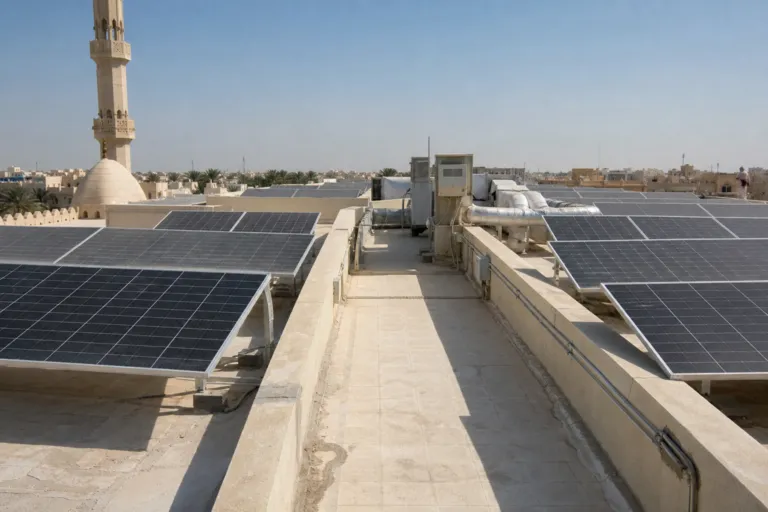
Solar retrofits move the discussion from saving energy to reshaping annual energy balance. A Saudi Arabia-focused near-zero-energy mosque study proposes an integrated retrofit package of 5 cm XPS wall insulation, 5 cm EPS roof insulation, double-glazed windows, and a 34.4 kWp rooftop PV system. It reports the package reduced cooling demand by approximately 25% and generated a 59% annual energy surplus, alongside an economic payback period of 9.4 years. The same study also states that large-scale deployment across Saudi mosques could reduce national CO2 emissions by up to 725,000 tons annually. Together, these figures show why PV is increasingly explored as an active retrofit in hot and hot-arid regions with substantial cooling-driven electricity demand.
For decision-makers, the pattern across sources is consistent: prioritize measures with the highest impact on cooling demand, then lock in additional gains through lighting and control strategies, and finally evaluate PV as a capital project with measurable payback. Reviews also emphasize that shading can help when dimensioned to local sun paths and targeted to periods of high solar altitude, but it is typically modest compared with envelope insulation or system-level measures. In parallel, market commentary on smart buildings in Saudi Arabia points to increasing emphasis on advanced lighting, heating, and cooling technologies and to energy management solutions that minimize building energy consumption. In practice, a retrofit roadmap for mosques should be built around local climate, occupancy behavior, and transparent performance evaluation.
What retrofits show the clearest results for mosque energy efficiency in Saudi Arabia?
How much can cooling demand drop with an integrated retrofit and rooftop PV in a Saudi mosque study?
What payback period is reported for a near-zero-energy mosque retrofit package in Saudi Arabia?
Do shading-only measures deliver big energy reductions in Saudi mosques?
What national electricity context is cited for buildings in Saudi Arabia?
Talk to us for your needs in:
-
Energy Efficiency Strategy & Feasibility
-
Renewable Energy Strategy & Investment Advisory
-
Digital Energy & Smart Grid Strategy
-
Market Entry Strategy
-
Sustainability & Impact Strategy
-
Energy Project Governance & PMO Advisory
-
Energy Market Research
-
Energy Stakeholder & Customer Research
-
Energy Market Intelligence
-
Energy Feasibility & Investment Assessment
-
Energy Sector Benchmarking & Performance Strategy