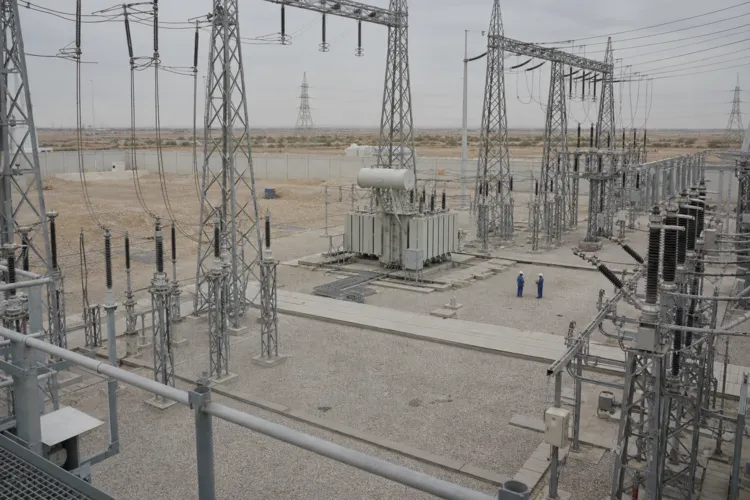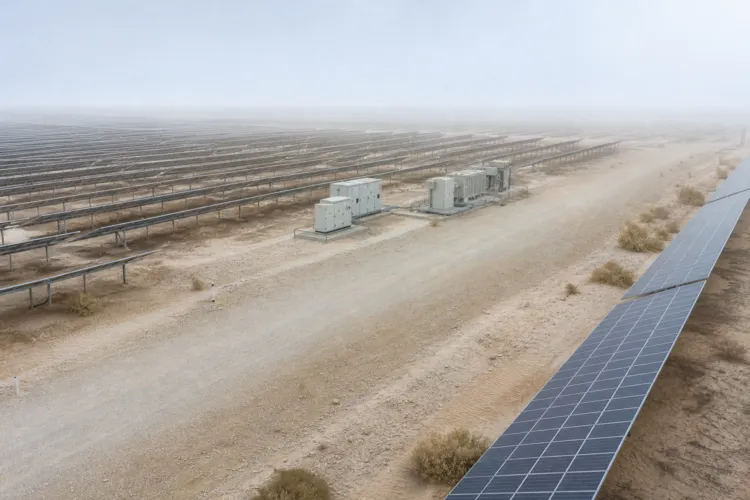

Saudi Arabia’s grid challenge is clear: the best renewable resources are not always located near the biggest demand centers. A global HVDC report notes that solar in desert regions is rarely co-located with population and industrial demand, creating a transmission problem that HVDC is positioned to solve. In Saudi Arabia, demand conditions reinforce the need for long-distance bulk transfer. National electricity consumption exceeded 340.4 TWh in 2024 and increased 4.1% annually, while peak demand reached 74.8 GW. These system realities strengthen the case for high-capacity corridors with controllable power flows and lower long-distance losses than equivalent AC solutions.
Where the renewables are being built also matters for transmission design. Saudi Arabia’s Northern Border and Tabuk host most greenfield renewable projects because solar irradiation and wind resources rank among the best nationwide, yet weak transmission connections to Riyadh and Jeddah can increase curtailment until HVDC corridors come online after 2027. Mordor Intelligence reports that two 3 GW HVDC links are scheduled for completion in 2027 to move surplus power from northern solar and wind farms to central demand centers. It also describes a 90,000 km transmission grid resting on a 380 kV backbone that can transfer only 15 GW across major regions, leaving Tabuk and Northern Border clusters exposed to curtailment until new HVDC service begins after 2027.
Market Momentum and Technology Choices in Saudi HVDC
The market indicators point to sustained buildout. Grand View Research estimates the Saudi Arabia HVDC transmission market generated USD 972.6 million in revenue in 2024 and is expected to reach USD 1,286.5 million by 2030, with Saudi Arabia accounting for 2.4% of the global HVDC transmission market in 2024. It also reports that line commutated converter (LCC) was the largest segment with a 68.42% revenue share in 2024. Ken Research, using a different forecast frame, projects the Saudi Arabia HVDC Transmission Market to increase from USD 1.02 billion in 2025 to USD 1.94 billion by 2031, representing an 11.30% forecast CAGR, and notes that VSC-HVDC is the fastest-growing segment over 2026–2031.
Saudi Arabia’s use cases go beyond moving renewables from the desert to cities. Mobility Foresights describes HVDC systems in the country as being deployed across long-distance corridors connecting remote renewable generation zones to load centers, offshore wind farm power evacuation routes, asynchronous AC interconnection links, and cross-border regional electricity market integration projects. The same source highlights why VSC technology is gaining attention, citing reactive power control, black start capability, and compatibility with offshore wind grid connections. It also links project viability to improvements in modular multilevel converter topology efficiency, extruded polymer cable insulation technology, and DC grid protection systems that enhance reliability in increasingly complex grid integration applications.
Planning is also shaped by where demand is concentrated and how it spikes. Mordor Intelligence states the Western Province, including Jeddah, Makkah, and Madinah, represents 25% of demand and sees temporary increases of 3–4 GW during Hajj and Umrah seasons, which require fast-start capacity. Ken Research adds that HVDC activity is concentrated across the Central, Western, and Northern operating areas, where renewable projects, giga-project demand, and cross-border links converge. It also reports Saudi Arabia’s transmission network reached 99,794 circuit-km in 2024, supported by 1,260 transmission substations and 497,902 MVA of substation capacity. In this context, hvdc transmission saudi arabia is increasingly framed as both an energy-transition enabler and a grid-operability tool for controllable delivery between generation clusters and load centers.
Why is HVDC important for moving Saudi Arabia’s desert renewables to cities?
What HVDC projects are scheduled to help transfer power from the north?
How big is the HVDC transmission market in Saudi Arabia, according to published estimates?
Which converter technology led revenue share in 2024, and which is forecast to grow faster?
What does the Saudi grid baseline look like in recent statistics?
Talk to us for your needs in:
-
Energy Efficiency Strategy & Feasibility
-
Renewable Energy Strategy & Investment Advisory
-
Digital Energy & Smart Grid Strategy
-
Market Entry Strategy
-
Sustainability & Impact Strategy
-
Energy Project Governance & PMO Advisory
-
Energy Market Research
-
Energy Stakeholder & Customer Research
-
Energy Market Intelligence
-
Energy Feasibility & Investment Assessment
-
Energy Sector Benchmarking & Performance Strategy