Saudi Arabia’s energy buildout sits alongside a more demanding localization agenda. The Ministry of Energy’s spending on power and renewable energy projects is expected to reach USD 293 billion by 2030, while Mordor Intelligence forecasts the power generation market growing from 87.81 GW in 2024 to 116.41 GW by 2029 at a 5.80% CAGR. In this context, local content expectations increasingly shape who can bid, how projects are executed, and which supply chains win. The National Renewable Energy Program (NREP) is a key mechanism, using bankable, sovereign-backed offtake structures while also mandating local content thresholds as part of its regulatory and procurement architecture.
In practice, localization is becoming an eligibility and competitiveness lever. MarkWide Research notes that NREP domestic content rules are pulling module assembly and inverter production into the Kingdom, creating more captive supply chains that EPC contractors can bundle into turnkey offers. The same report highlights that the NREP’s local content requirements are forcing technology suppliers to establish domestic manufacturing or forfeit eligibility for government-anchored tenders. For renewable developers, that interacts with technical and certification frameworks tied to SEC grid codes and SASO technical specifications for equipment certification, while SFDA industrial safety mandates and GOSI contractor qualification requirements shape labor and site access for foreign EPC firms.
What “Local” Now Means: From Percentages to Proof
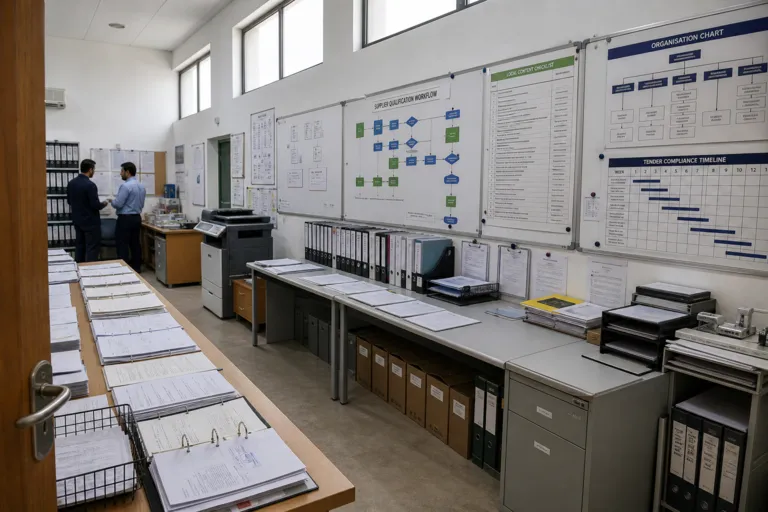
Advisory analysis from Grant Thornton describes a shift from a simple threshold mindset toward a more mature, data-driven regime aligned with Vision 2030 objectives like economic diversification, industrial capability building, and long-term value creation. The same source notes that project-level obligations are becoming more sophisticated, often with bespoke targets, monitoring milestones, and post-award reporting requirements across large capital projects, joint ventures, and multi-tier supply chains. This is where local content requirements in Saudi energy projects become operational: governance structures, calculation methodologies, reporting controls, bid modeling, compliance reviews, and post-award monitoring can influence bid scoring and delivery execution.
Multiple localization tracks can apply at once, depending on the project owner and sector. The U.S. International Trade Administration notes Saudi Aramco’s In-Kingdom Total Value Added (IKTVA) program aims to retain Aramco’s percentage of locally manufactured energy-related goods and services at a minimum of 70%. The same source describes the “EPP,” administered by the Ministry of Industry, the LCGPA, and sector-specific authorities, requiring bidders on major government and state-owned enterprise contracts to commit to defined levels of local economic contribution, including Saudi employment, local sourcing, technology transfer, training, and establishing regional headquarters. While the ITA also cites a 50% by 2030 target for locally produced and procured defense materials, that figure is specific to defense and should be treated as contextual rather than an energy-sector mandate.
Localization pressure is also visible in emerging energy-adjacent technologies such as heavy-duty EV charging. IndexBox reports that import dependence is near 100% for fully integrated Megawatt Charging System (MCS) units and high-power semiconductor components, while local assembly and system integration partnerships are emerging. Standard-grade MCS units are estimated at USD 150,000–250,000 per connector in 2026, and volume procurement for large depots could reduce per-unit costs by 20–30% by 2030. IndexBox adds that local content requirements under Vision 2030 industrial localization programs are prompting joint ventures and technology transfer agreements, potentially positioning the Kingdom as a regional MCS assembly and distribution hub by 2032.
How are local content requirements shaping Saudi energy tenders under Vision 2030?
What local content benchmark does Saudi Aramco set through IKTVA?
What does Grant Thornton say is changing about Saudi local content compliance?
How do certification and approvals affect localized energy equipment market entry?
Talk to us for your needs in:
-
Energy Efficiency Strategy & Feasibility
-
Renewable Energy Strategy & Investment Advisory
-
Digital Energy & Smart Grid Strategy
-
Market Entry Strategy
-
Sustainability & Impact Strategy
-
Energy Project Governance & PMO Advisory
-
Energy Market Research
-
Energy Stakeholder & Customer Research
-
Energy Market Intelligence
-
Energy Feasibility & Investment Assessment
-
Energy Sector Benchmarking & Performance Strategy