DataVolt is positioning itself around a simple constraint: energy availability is the bottleneck for digital infrastructure. In an AI-driven world, CEO Rajit Nanda says modern facilities must pair huge computing power with resilient cooling and dependable energy. DataVolt was established in 2023 and builds and operates data centers across the Middle East and Central Asia. The company has five office locations worldwide, around 175 staff members, and multiple projects under development across Saudi Arabia and Uzbekistan. It targets hyperscalers, cloud providers, governments, and AI innovators that need infrastructure designed for high-density, high-performance deployments.
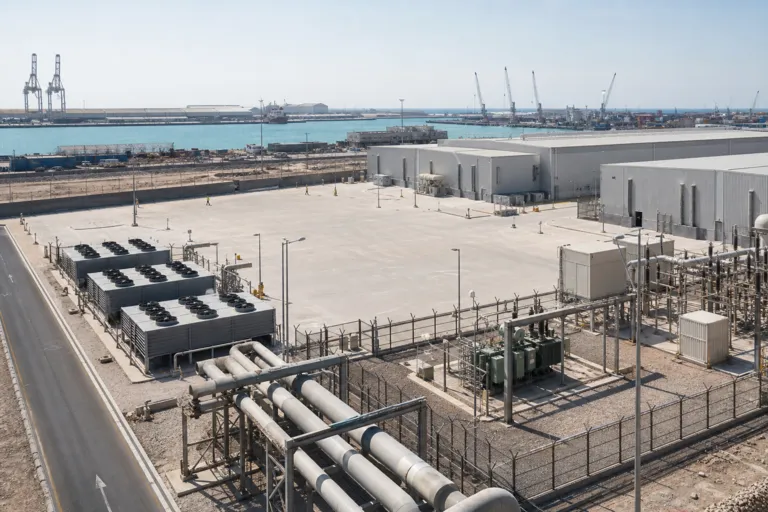
That strategy is now taking visible shape in Saudi Arabia through an agreement with NEOM to develop a large campus in Oxagon. Multiple reports describe a USD $5 billion first-phase investment tied to a 1.5 GW AI factory-style data center campus in Oxagon, NEOM’s industrial area and port hub on the Red Sea. The project is intended to be powered entirely by renewable energy and designed to operate at net zero, with advanced cooling technologies included to enhance energy efficiency. The campus is also described as integrating a wide range of computing densities and energy-efficient architectures to address power availability constraints and the carbon footprint challenges often associated with data centers.
Why Oxagon Is Being Positioned as a Site for Green AI
NEOM has pointed to Oxagon’s location on the Red Sea coast as a key reason for placing the campus there. The sources cite access to sub-sea cables for fiber connectivity, alongside cost-competitive renewable energy and green hydrogen. Under the agreement, Oxagon will lease land to DataVolt for the development and provide infrastructure support. Oxagon’s chief executive, Vishal Wanchoo, said the agreement sets the foundations for the first “green-AI” workload to come on-stream in Saudi Arabia, along with computing power intended for regional and global impact. In other words, the site is being framed as both an energy-and-connectivity play, not just a real estate choice.
The schedule and scale are central to how the campus is being described. The facility is expected to be operational by 2028, and one report adds that the first phase is rated at 300 MW. This timeline lands amid wider concerns about AI’s electricity demand: the International Energy Agency (IEA) is cited as predicting that AI-driven data center power usage could double by 2026. Those pressures are part of why the project narrative emphasizes net-zero operations, renewable power, and advanced cooling as design requirements rather than optional upgrades. It also fits Nanda’s stated view that computing infrastructure should be placed close to energy resources.
In parallel, DataVolt describes an “AI-first” approach that rethinks cooling architecture, campus layouts, and long-term scalability to support massive GPU clusters and accelerated computing. Nanda says DataVolt has in-housed its design and engineering team to keep flexibility as cooling and power technologies mature, and that its facilities use efficient designs and next-generation cooling systems suited to high power density deployments. As context for the region’s momentum, one source cites predictions that the Middle East data center sector could be worth USD $7.7 billion by 2030, driven by a 19.76 percent compound annual growth rate. Against that backdrop, the net-zero Oxagon campus is being positioned as a flagship for sustainable AI infrastructure in the Kingdom.
What is DataVolt building at NEOM’s Oxagon?
How much investment is tied to the first phase of the project?
When is the Oxagon AI campus expected to be operational?
Why was Oxagon selected as the location for the DataVolt Oxagon data center project?
What wider trend is influencing the push for net-zero AI data centers?
Talk to us for your needs in:
-
Energy Efficiency Strategy & Feasibility
-
Renewable Energy Strategy & Investment Advisory
-
Digital Energy & Smart Grid Strategy
-
Market Entry Strategy
-
Sustainability & Impact Strategy
-
Energy Project Governance & PMO Advisory
-
Energy Market Research
-
Energy Stakeholder & Customer Research
-
Energy Market Intelligence
-
Energy Feasibility & Investment Assessment
-
Energy Sector Benchmarking & Performance Strategy