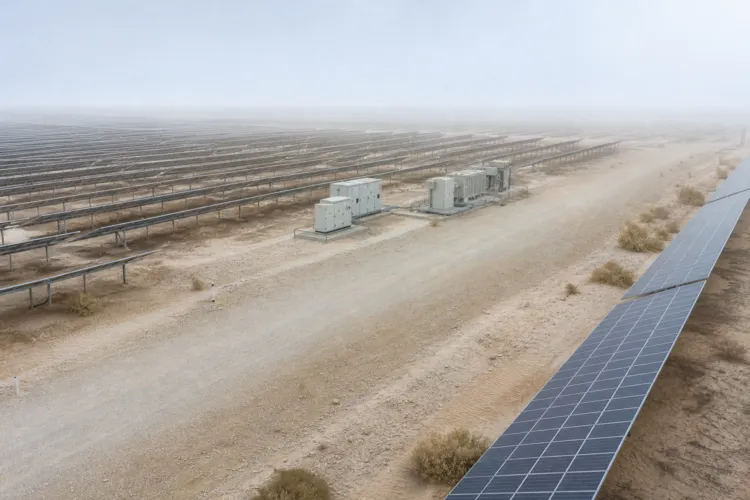
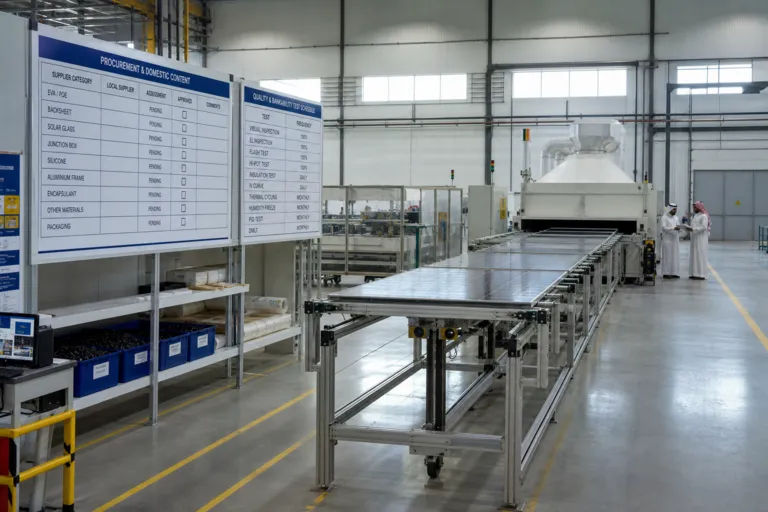
Saudi Arabia’s push to localize PV supply is unfolding alongside a fast-growing project pipeline. In the Middle East solar power market, tariffs in Saudi Arabia’s Round 6 tender fell below 1.1 US cents/kWh, a signal that procurement is becoming intensely cost-driven while still leaving room for domestic-content incentives. Regional solar irradiation is cited above 2,000 kWh/m²/yr, and parts of Saudi Arabia exceed 2,400 kWh/m², enabling single-axis trackers to reach 28%–32% capacity factors. In this setting, solar panel manufacturing in Saudi Arabia becomes less about headlines and more about supply assurance, landed-cost control, and how quickly the local ecosystem can qualify components for utility-scale deployment.
Localization also has named anchors. A 5 GW plant was inaugurated by Desert Technologies in Jeddah in 2024, and a separate TOPCon joint venture is described as JinkoSolar’s USD 1 billion partnership with Saudi Arabia’s Public Investment Fund, planned to deliver 10 GW/year from early 2026 and cut landed costs by up to 12%. Demand-side pull is equally clear in the same source: NEOM is referenced with 4 GW, framed as captive demand tied to a hydrogen hub. At the market level, Saudi Arabia is described as commanding 38.17% of installed capacity in 2025 and forecast to grow at a 30.6% CAGR through 2031, underpinned by a 130 GW renewable target.
Where LONGi and First Solar Fit Into a Localization-First Playbook
LONGi’s relevance to localized manufacturing debates often starts with its scale and the pricing pressures shaping global sourcing. One market source reports LONGi FY2024 revenue of CNY 85.2 Billion (about USD 11.7 Billion), down from CNY 129.5 Billion in FY2023, as module selling prices fell from around USD 0.22 per watt in early 2023 to below USD 0.10 per watt in late 2024. The same source attributes the broader squeeze to overcapacity, noting roughly 500 GW of annual module capacity added in China above global installation demand of 390 to 447 GW. For Saudi buyers, this global context can lower near-term module pricing, but it also strengthens the case for local assembly and qualified domestic supply when tenders reward local content or when shipping and lead-time risk matters.
First Solar enters the Saudi conversation differently: as a reference point for how policy-driven procurement can reshape supply chains. One source states First Solar’s US-manufactured cadmium telluride panels command a significant share of US utility-scale procurement where domestic content bonus tax credits incentivize sourcing US-manufactured modules, and that First Solar disclosed a manufacturing shipment backlog contracted through 2029. That does not describe production in Saudi Arabia, but it provides a clear comparison for how “domestic content” frameworks can translate into bankable order books. In the Middle East and Africa, the same source expects expanding revenue growth over the forecast period and names Saudi Arabia among the primary markets, aligning with the Kingdom’s stated focus on scaling projects while strengthening local industry capability.
Localization is not limited to modules. Saudi Arabia’s floating solar segment illustrates how adjacent hardware can be pulled into local manufacturing strategies. An IndexBox report notes import duties on PV modules are zero under Saudi Arabia’s WTO commitments, while a 5% customs duty applies to HDPE floats and steel structures imported from outside the GCC. It also projects FPV system prices to decline to USD 0.90–1.10/Wp by 2028 and USD 0.80–1.00/Wp by 2030 as project scale increases and local float manufacturing ramps up. Taken together, these details show why the localization discussion often spans modules, structures, and qualification-heavy components, not just panel lines.
What is driving solar panel manufacturing in Saudi Arabia right now?
What local manufacturing capacity has been cited in Saudi Arabia so far?
How does LONGi’s global pricing context affect procurement decisions in Saudi Arabia?
Does the source material say First Solar manufactures in Saudi Arabia?
What numbers are given for floating solar costs and duties in Saudi Arabia?
Talk to us for your needs in:
-
Energy Efficiency Strategy & Feasibility
-
Renewable Energy Strategy & Investment Advisory
-
Digital Energy & Smart Grid Strategy
-
Market Entry Strategy
-
Sustainability & Impact Strategy
-
Energy Project Governance & PMO Advisory
-
Energy Market Research
-
Energy Stakeholder & Customer Research
-
Energy Market Intelligence
-
Energy Feasibility & Investment Assessment
-
Energy Sector Benchmarking & Performance Strategy