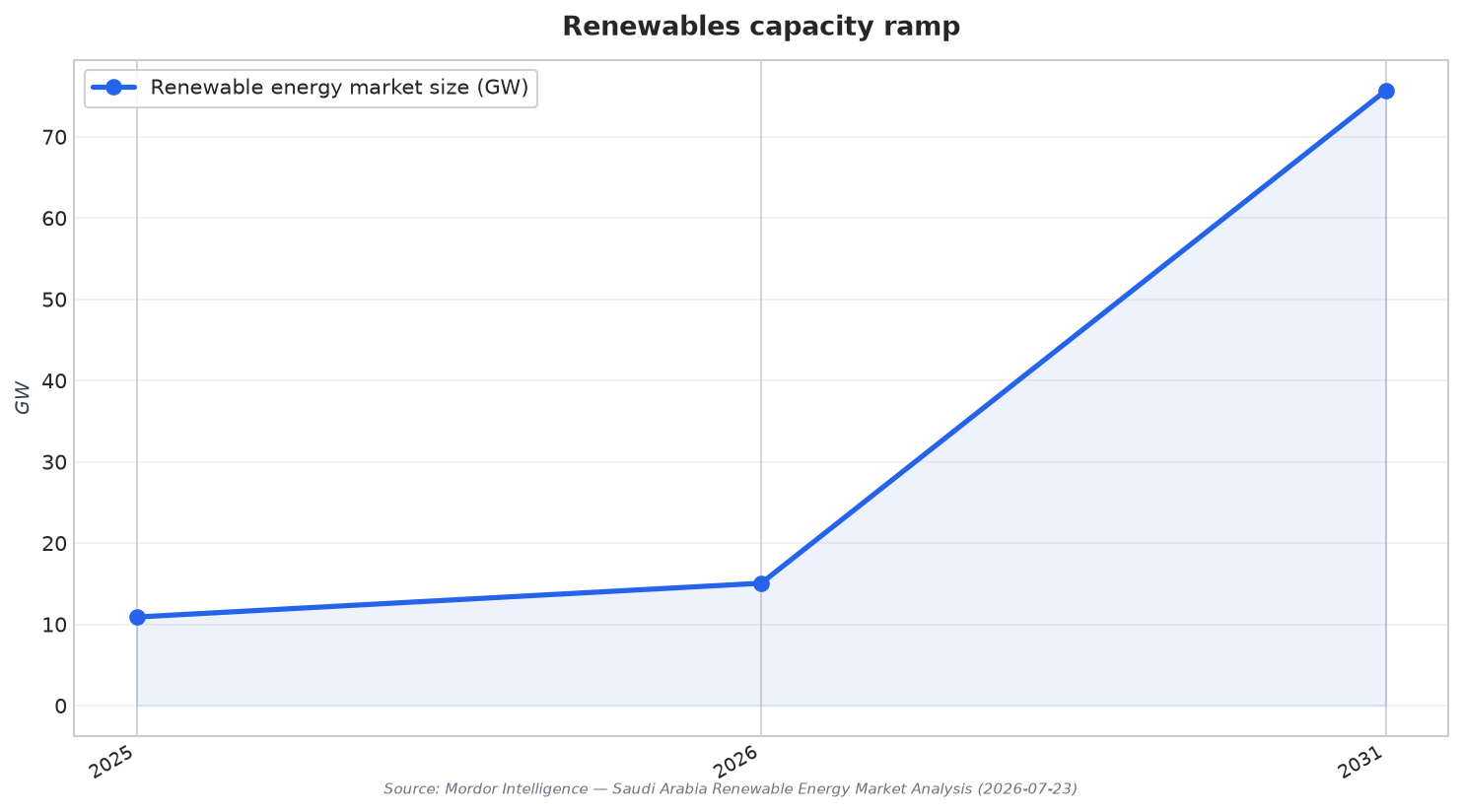
Managing renewable energy curtailment in Saudi Arabia is becoming a practical grid question, not a theoretical one. Mordor Intelligence estimates the Saudi Arabia renewable energy market size at 15.06 GW in 2026, up from 10.90 GW in 2025, with projections reaching 75.68 GW by 2031 and a 38.12% CAGR over 2026–2031. At the same time, the U.S. Commercial Service notes the wider power generation market is expected to grow from 87.81 GW in 2024 to 116.41 GW by 2029. As renewable output climbs quickly, the system must move energy to where it is needed, when it is needed, or accept periods where solar and wind are available but cannot be fully used.
Saudi Arabia’s development pattern makes curtailment risk very location-specific. Mordor’s power market analysis says Northern Border and Tabuk host most greenfield renewable projects because resources rank among the best nationwide, yet weak transmission connections to Riyadh and Jeddah increase curtailment until HVDC corridors come online after 2027. This is happening while the Western Province (Jeddah, Makkah, and Madinah) represents 25% of demand and sees temporary increases of 3–4 GW during Hajj and Umrah seasons, which require fast-start capacity. In other words, renewable supply is clustering in the north, while major demand centers and operational peaks sit elsewhere, tightening grid flexibility.
Grid Buildout, Smarter Siting, and Procurement Signals
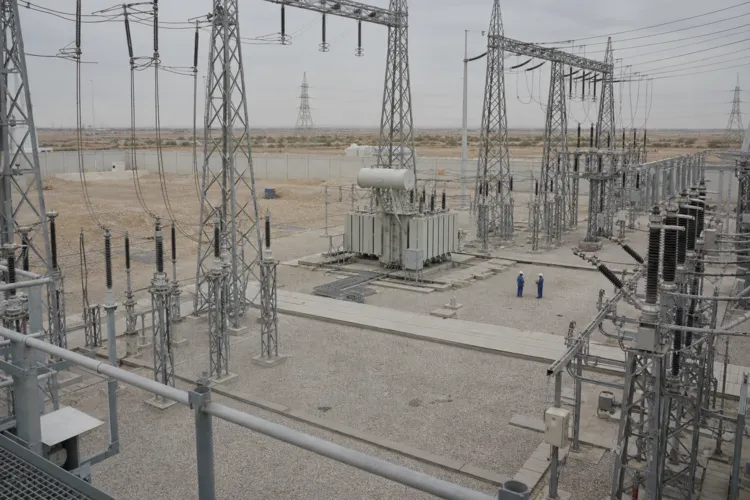
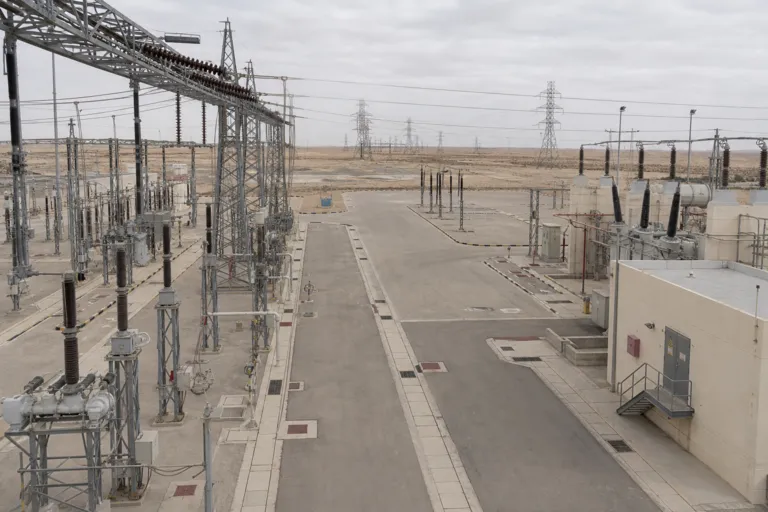
Grid investment is one of the clearest levers to reduce curtailment. The U.S. Commercial Service reports Saudi Electricity Company (SEC) is ramping up investments in grid infrastructure, including a 2023 capex program of $10.9 billion, a 51.8% increase from 2022. It also reports that in 2024 SEC deployed $16 billion into generation, transmission, distribution, and general projects, a 43.8% increase on the previous year, and that SEC’s directly owned capacity stood at 56.4 GW (61% of the Kingdom’s total). On the transmission side, Mordor’s power market analysis says Hitachi Energy holds contracts for HVDC converter stations that will move 3 GW from Tabuk to Riyadh, explicitly framed as reducing curtailment risk in the northern renewable cluster.
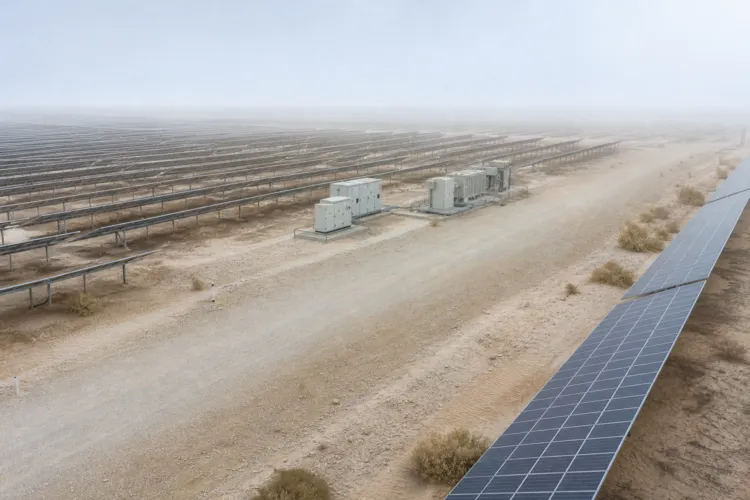
Project siting and diversification also matter, because they can spread production across resource zones and grid nodes. Mordor’s renewable energy market report highlights project clustering in the Northern Borders and Tabuk regions and notes that geographic diversification can mitigate curtailment. It also describes operational headwinds that influence real-world output, including dust-driven PV efficiency losses of 15–20% annually and grid congestion in high-solar regions. Those constraints interact with procurement speed: Mordor’s power market analysis says the National Renewable Energy Program (NREP) has awarded 21 projects totaling 19 GW, with seven plants equal to 4.1 GW operating by late 2024. It also states grid-connected renewables climbed to 6.5 GW in 2024 and are scheduled to double to 12.7 GW in 2025, increasing the urgency of grid-ready rollout.
Finally, price signals and offtake structure shape how quickly capacity is added and how it is integrated. Mordor reports cost-competitive solar tariffs averaging USD 0.018/kWh and notes tenders with record-low tariffs below USD 0.018/kWh. Its power market analysis adds examples of low-priced projects, citing Sakaka Solar closing at 2.32 cents/kWh and Dumat Al Jandal Wind at 2.13 cents/kWh. Low tariffs support growth, but curtailment management still depends on planning transmission and demand pull alongside procurement. The U.S. Commercial Service states Saudi Arabia has pledged to generate 50% of the country’s electricity from renewable sources by 2030, and also notes Ministry of Energy spending on power and renewable energy projects is expected to reach $293 billion by 2030. Aligning that spending with transmission timing, north-to-load corridors, and faster interconnection can help ensure new solar and wind reduce fuel burn rather than sit behind constraints.
Why is renewable curtailment risk rising as Saudi Arabia scales solar and wind?
What grid projects are mentioned that could reduce curtailment in Saudi Arabia?
How fast are grid-connected renewables expanding in the Kingdom?
What non-grid operational issue can affect solar output and planning?
Talk to us for your needs in:
-
Energy Efficiency Strategy & Feasibility
-
Renewable Energy Strategy & Investment Advisory
-
Digital Energy & Smart Grid Strategy
-
Market Entry Strategy
-
Sustainability & Impact Strategy
-
Energy Project Governance & PMO Advisory
-
Energy Market Research
-
Energy Stakeholder & Customer Research
-
Energy Market Intelligence
-
Energy Feasibility & Investment Assessment
-
Energy Sector Benchmarking & Performance Strategy