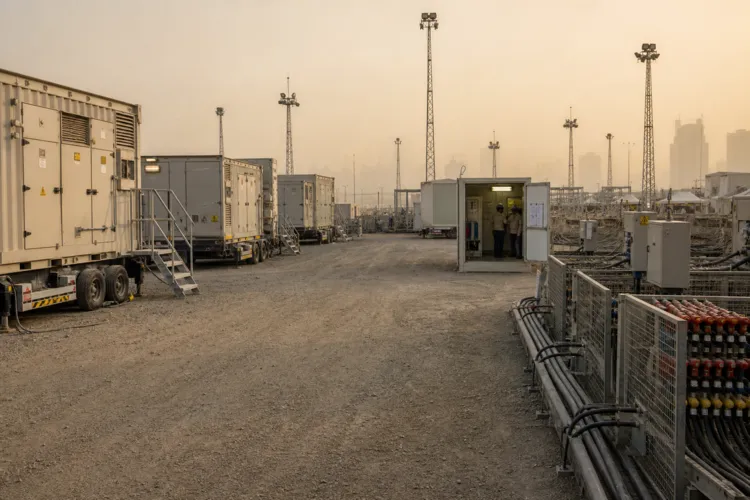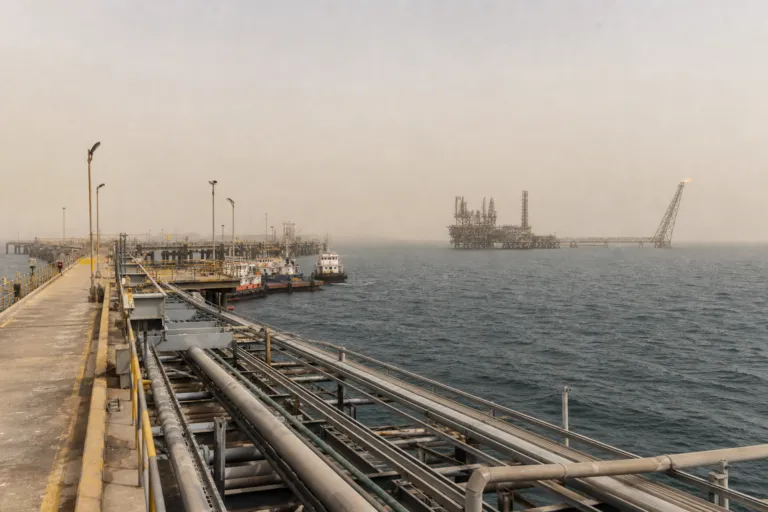
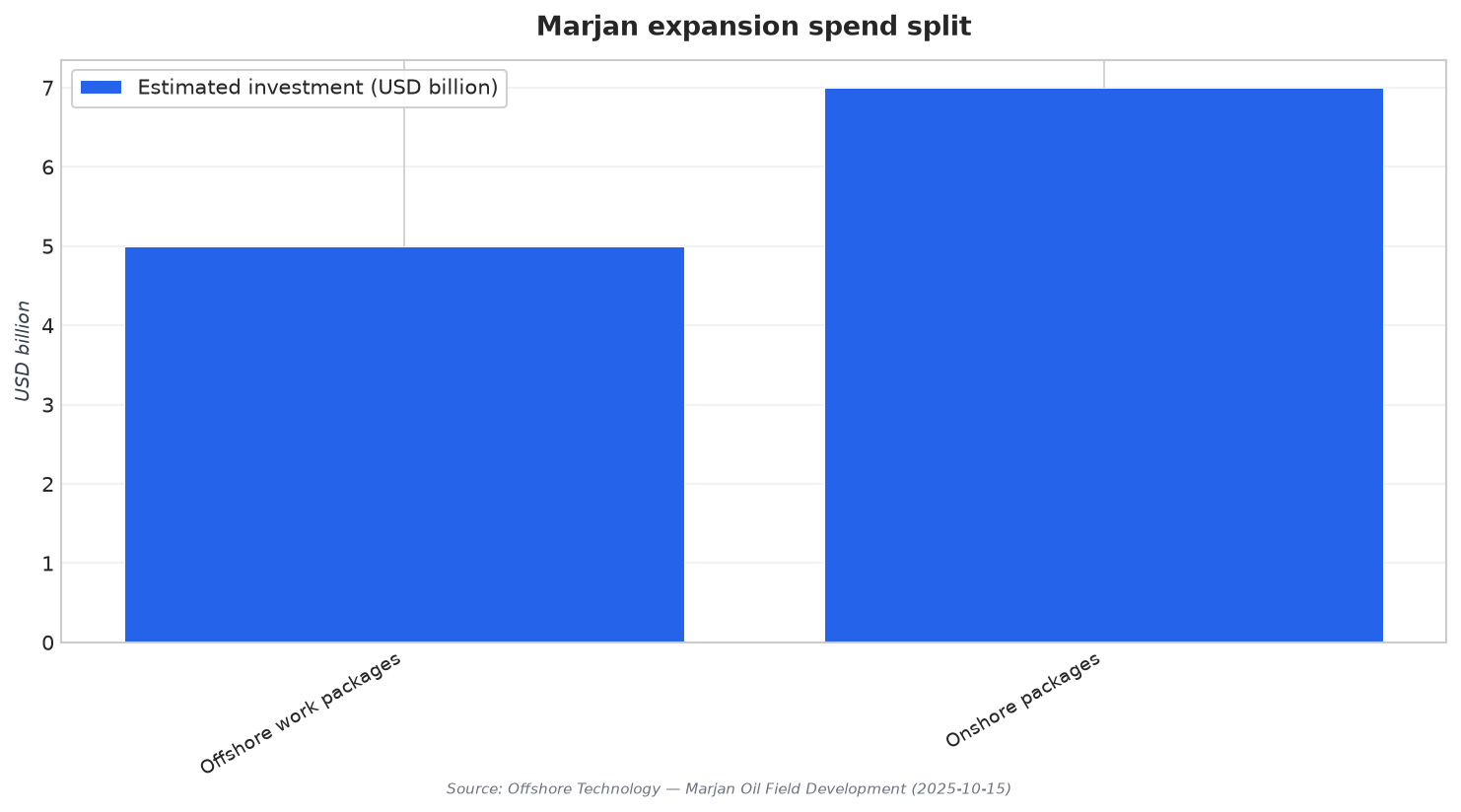
The Marjan oil and gas field sits in the Arabian Gulf off Saudi Arabia’s eastern coast, and it is owned and operated by Saudi Aramco. The field is being expanded under the Marjan Crude Increment Programme, announced in 2017. The stated aim is to increase Marjan crude production capacity by 300,000 barrels per day (bpd) and produce 360,000 bpd of ethane and natural gas liquids (NGL) by processing an additional 2.5 billion standard cubic feet per day (Bscfd) of gas from the field. The Marjan programme is described as being implemented through multiple work packages with an estimated total investment of USD 12 billion, including offshore packages valued at USD 5 billion and onshore packages estimated at up to USD 7 billion.
That Marjan build-out is part of a wider spending wave tied to the marjan berri offshore expansion topic: Saudi Aramco’s USD 18 billion investment programme to boost the production capacity of the Marjan and Berri offshore fields by 550,000 bpd of crude oil and 2.5 Bscfd of gas. Another source notes Aramco originally awarded USD 18 billion worth of contracts for the combined Marjan and Berri expansion programs in 2019. For Marjan specifically, the same combined program scope included a new offshore gas-oil separation plant (GOSP), 24 offshore oil, gas, and water-injection platforms, and expanded onshore processing infrastructure. Aramco also confirmed earlier this year that its Marjan crude oil increment had started production, adding 300,000 bpd of capacity.
What’s Being Built Offshore and Onshore at Marjan
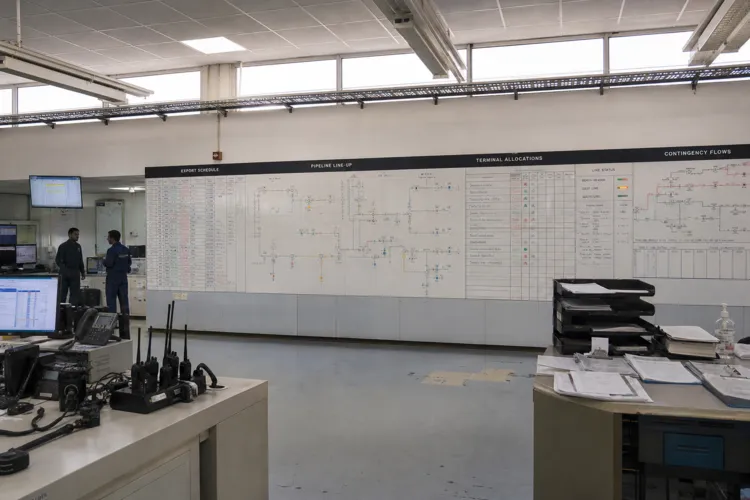
Marjan’s existing infrastructure already includes three offshore GOSPs. Marjan GOSP-1, installed in 1973, had a production capacity of 100,000 bpd of oil and 175 million standard cubic feet a day (Mscfd) of gas. GOSP-2 and GOSP-3 came online in 1994 and brought total offshore capacity to 600,000 bpd of oil and 675 Mscfd of gas. Produced oil and gas are piped onshore to Tanajib for further processing, and the onshore control centre at Tanajib controls operations at the Marjan oilfield. The new expansion scope adds major offshore and onshore elements to this base, including an offshore GOSP complex called Marjan GOSP-4, described as within 10 km of the GOSP-2 and GOSP-3 facilities.
The offshore works described for the Marjan Crude Increment Programme include the development of 24 oil, water, and gas injection platforms, 200 km of cables, and additional tie-in platforms, production decks, and subsea export and infield pipelines. Package 1 includes installing six platforms weighing between 4,500 tonnes (t) and 6,700 t, with a maximum footprint of 90 m x 52 m, plus 12 interconnecting bridges and multiple deck levels. The offshore plan also covers replacing decks on two existing tie-in platforms, removing existing gas turbine generators, and installing two 115 kV subsea power and communication cables. Onshore, the Tanajib processing complex expansion includes adding a gas plant, plus a new NGL recovery and fractionation facility and additional gas compression facilities.
Aramco’s follow-on work also points to a longer runway of upgrades after major construction. A later contract award describes multibillion-dollar expansions intended to maintain a crude production capacity of approximately 800,000 bpd at Marjan, while significantly increasing associated gas processing. Under that award, KBR is expected to support upgrades tied to offshore processing, gas compression, and power infrastructure, and to integrate digital technologies, automation, and power-system enhancements to strengthen long-term performance of critical offshore assets. Separately, Marjan’s longer history helps frame why offshore infrastructure matters: the field was discovered in 1967 and was originally estimated to contain 2.31 billion barrels of recoverable crude oil, while Saudi Aramco’s own historical account notes exploration confirmed the Berri field after the 1963 identification of Abu Sa‘fah and before later offshore discoveries including Marjan in 1967.
What is Aramco trying to achieve with the Marjan and Berri offshore expansion programs?
Where is the Marjan oil and gas field located?
What are the key offshore components of the Marjan Crude Increment Programme?
What production capacity is expected for the Marjan field after the expansion?
Talk to us for your needs in:
-
Energy Efficiency Strategy & Feasibility
-
Renewable Energy Strategy & Investment Advisory
-
Digital Energy & Smart Grid Strategy
-
Market Entry Strategy
-
Sustainability & Impact Strategy
-
Energy Project Governance & PMO Advisory
-
Energy Market Research
-
Energy Stakeholder & Customer Research
-
Energy Market Intelligence
-
Energy Feasibility & Investment Assessment
-
Energy Sector Benchmarking & Performance Strategy