Extending solar generation into evening and night hours is a core promise of molten-salt thermal energy storage in Saudi Arabia, especially when it is paired with concentrating solar power (CSP). In the Saudi Arabia solar energy market, thermal storage of up to 15 hours is described as enabling dispatch beyond sunset and reducing reliance on gas peakers. The same source notes that CSP can deliver about 12–15 hours of stored energy, but also highlights a cost range of USD 3,500–5,000/kW, along with added engineering complexity from molten-salt loops and specialized turbines. That tradeoff helps explain why the technology is framed as a “strategic complement” rather than a universal replacement.
Saudi Arabia’s solar buildout provides the broader backdrop for where dispatchable solar could fit. One market estimate puts Saudi Arabia’s solar energy market size at 10.25 GW in 2025 and 13.47 GW in 2026, with a projection of 52.72 GW by 2031 and a stated 31.40% CAGR over 2026–2031. The same view points to Vision 2030 mandates and streamlined REPDO tenders as factors supporting investor momentum, and it also notes that utility procurements now embed battery storage and local-content thresholds. Against that pace, molten-salt storage is positioned around niches that value firm output and usable heat, including NEOM, industrial clusters, and remote desalination plants.
What Global CSP and Molten-Salt Trends Signal for Saudi Projects
Outside Saudi Arabia, the installed base and market indicators help frame maturity and scale. One market report states that by the end of 2021, roughly 27,500 MWh of molten-salt TES capacity was installed globally across CSP plants, and that molten-salt systems account for about 50% of thermal storage capacity in CSP plants worldwide. It also says that parabolic trough plus molten salt constitutes about 60% of installed thermal storage systems, and that Europe holds about 43% share of molten-salt TES deployments by capacity. For context on CSP more broadly, the same source cites global CSP capacity of about 6.7 GW as of 2024, and notes that Noor Energy 1 added about 400 MW in 2023.
Project examples from the United States show how molten-salt storage is discussed in terms of dispatchable energy. Crescent Dunes in Nevada is described as a 110 MW CSP plant with 1,100 MWh of molten-salt storage, or about 10 hours. Solana is described as a CSP trough setup delivering over 1,000 MWh of dispatchable molten-salt energy. Another market view adds that nearly 49% of CSP capacity uses molten-salt storage for night-time power delivery, and that the Middle East & Africa hold nearly 14% of the market due to solar resources. For developers tied to Saudi Arabia, a company profile notes ACWA Power is based in Saudi Arabia and is characterized as managing ambitious CSP-plus-storage pipelines.
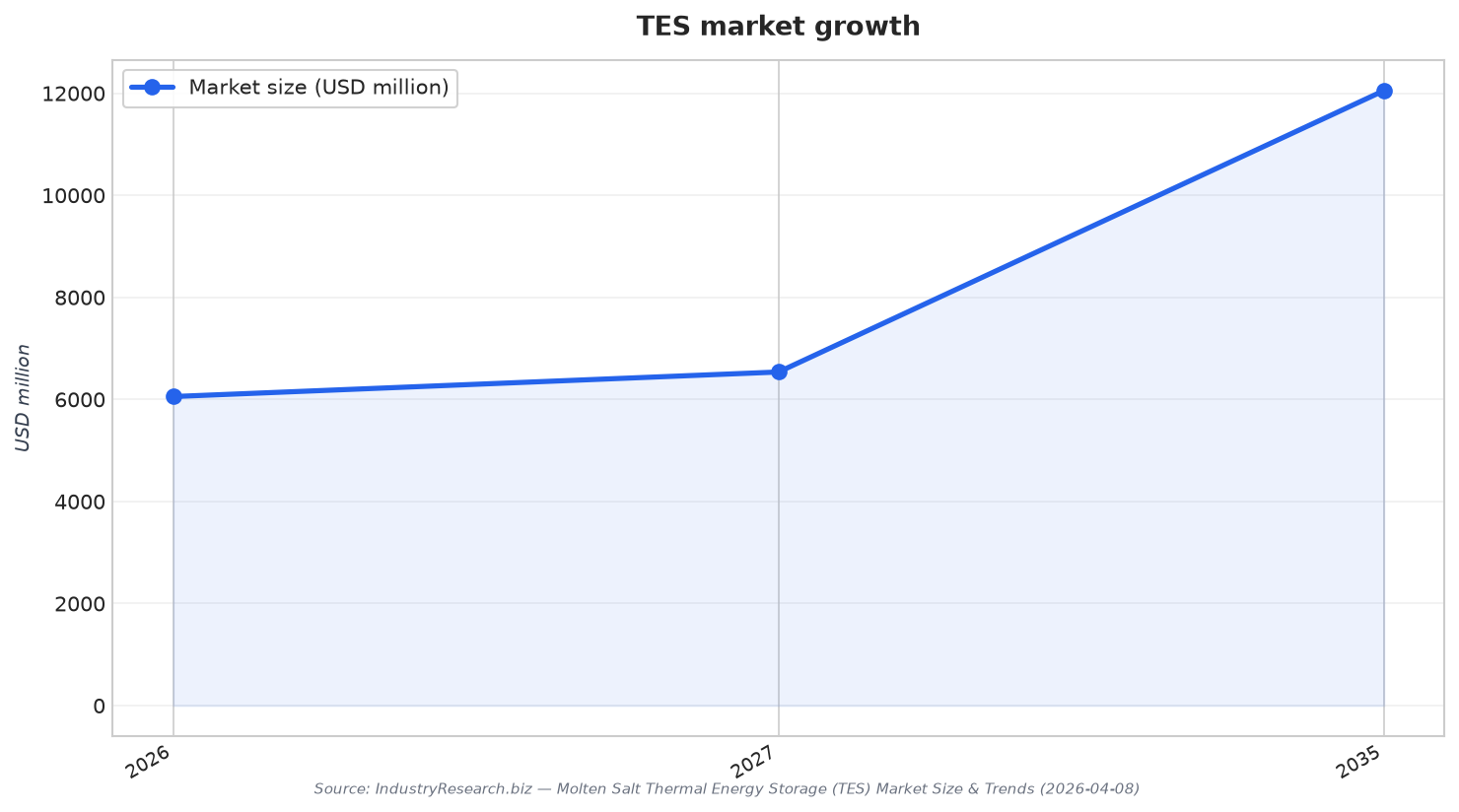
Commercial momentum is also described through market sizing and constraints that can shape procurement decisions. One global estimate projects the molten-salt TES market growing from USD 6,056.21 million in 2026 to USD 6,537.68 million in 2027, reaching USD 12,052.01 million by 2035, with a stated 7.95% CAGR. Another estimate values the molten-salt thermal energy storage market at USD 4.82 billion in 2025 and forecasts crossing USD 14.06 billion by 2035, with more than 11.3% CAGR over 2026–2035. On the engineering side, one report flags that about 20,000 km of high-temperature piping can cause 5%–10% thermal loss, a reminder that “solar into the night” depends on careful system design as much as solar resource strength.
How does molten-salt thermal energy storage help Saudi Arabia extend solar after sunset?
What cost range is cited for CSP with thermal storage in Saudi market coverage?
How much molten-salt TES capacity was installed globally by end of 2021?
What do U.S. project examples show about molten-salt storage scale?
Talk to us for your needs in:
-
Energy Efficiency Strategy & Feasibility
-
Renewable Energy Strategy & Investment Advisory
-
Digital Energy & Smart Grid Strategy
-
Market Entry Strategy
-
Sustainability & Impact Strategy
-
Energy Project Governance & PMO Advisory
-
Energy Market Research
-
Energy Stakeholder & Customer Research
-
Energy Market Intelligence
-
Energy Feasibility & Investment Assessment
-
Energy Sector Benchmarking & Performance Strategy