Saudi Arabia’s approach to greener construction is increasingly defined by regulation, not only by voluntary sustainability ambitions. The Saudi Building Code (SBC) is described as a collection of legislative, administrative, and technical rules for new buildings, and the Green Building code sits within it to promote green practices focused on energy efficiency and CO2 emissions reduction. In practice, this turns sustainability into a compliance topic for designers, contractors, and developers. It also creates a clearer baseline for what “efficient” should mean in a country building at scale under Vision 2030.
A key enforcement shift arrived in 2023. Sources describe the implementation of the SBC as setting rigorous energy-efficiency standards that are mandatory for all new constructions, with compliance enforced through design and construction requirements. These requirements are framed around measures such as enhanced insulation, efficient HVAC systems, and smart energy management solutions. The policy direction also includes an explicit outcome target: the framework aims to curtail energy consumption in the building industry by 30% by 2030. That combination—mandatory scope plus an outcome target—signals that efficiency is expected as standard delivery, not an add-on.
What the Rules Change on Real Projects
Evidence from simulation-based research suggests the SBC can materially change residential energy performance when envelope provisions are applied well. One assessment reports that SBC envelope provisions led to significant reductions in energy use in most cases, particularly for compact buildings such as apartments (APTs). It also links these improvements to higher Mostadam ratings, with APTs achieving up to 98% A+ ratings in the SBC context. The same body of findings notes that reductions in a specific climate zone (CZone-2) may have reached 20%–25%, while also arguing for ongoing monitoring and operational adjustments to maintain gains over time.
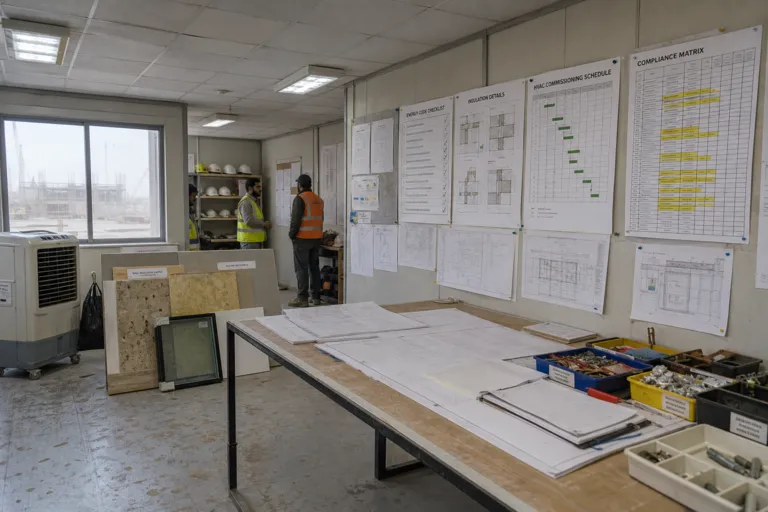
Thermal insulation is one of the most visible “code-to-site” requirements. Sources describe mandatory thermal insulation codes under the SBC that require building envelopes to meet defined energy performance levels across residential, commercial, and industrial construction. They also state that the Saudi Energy Efficiency Center (SEEC) actively audits compliance, raising the bar from specification to verification. For the supply chain, the message is straightforward: insulation becomes a baseline requirement rather than a discretionary upgrade, especially for hotels, offices, retail complexes, and industrial facilities that must meet defined performance levels and satisfy project tender expectations.
Market and procurement dynamics reinforce the regulatory push. One market source describes green construction technology as expanding fastest as SEEC mandates and LEED-equivalent certifications become standard on public tenders. Another industry report values the Saudi Arabia energy-efficient buildings market at USD 1.35 billion and ties growth to Vision 2030 priorities such as energy efficiency, sustainability, and carbon emission reduction through stringent regulations like the SBC. For stakeholders searching for “green building code Saudi Arabia” guidance, the practical takeaway is to treat energy efficiency as a required design input, a documented compliance process, and a procurement differentiator—particularly on government-linked megaproject delivery channels.
What is Saudi Arabia’s green building code in practice?
When did the SBC make energy-efficiency standards mandatory for new construction?
What outcome does the framework target for building energy use by 2030?
Do SBC envelope provisions show measurable benefits in residential buildings?
How is thermal insulation treated under the SBC, and who checks compliance?
Talk to us for your needs in:
-
Energy Efficiency Strategy & Feasibility
-
Renewable Energy Strategy & Investment Advisory
-
Digital Energy & Smart Grid Strategy
-
Market Entry Strategy
-
Sustainability & Impact Strategy
-
Energy Project Governance & PMO Advisory
-
Energy Market Research
-
Energy Stakeholder & Customer Research
-
Energy Market Intelligence
-
Energy Feasibility & Investment Assessment
-
Energy Sector Benchmarking & Performance Strategy