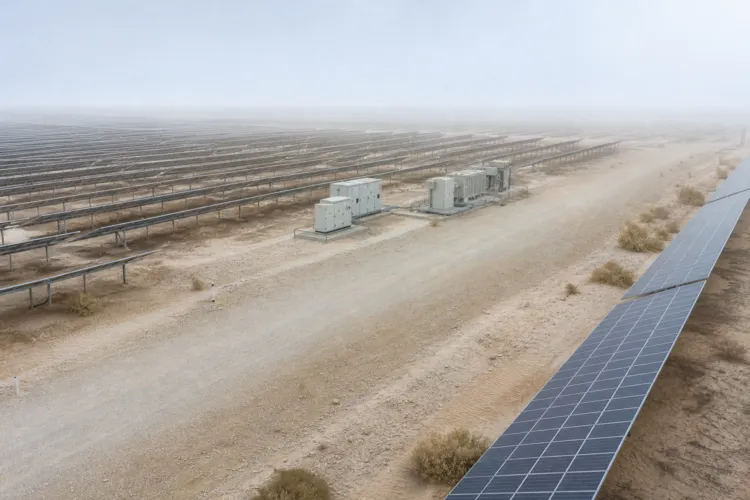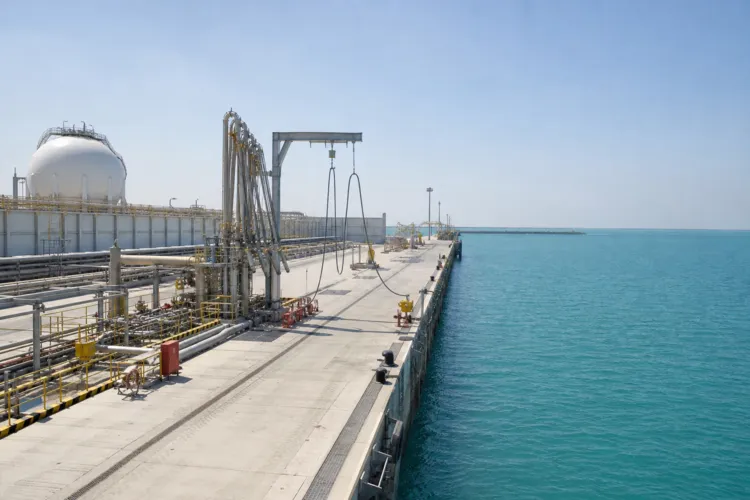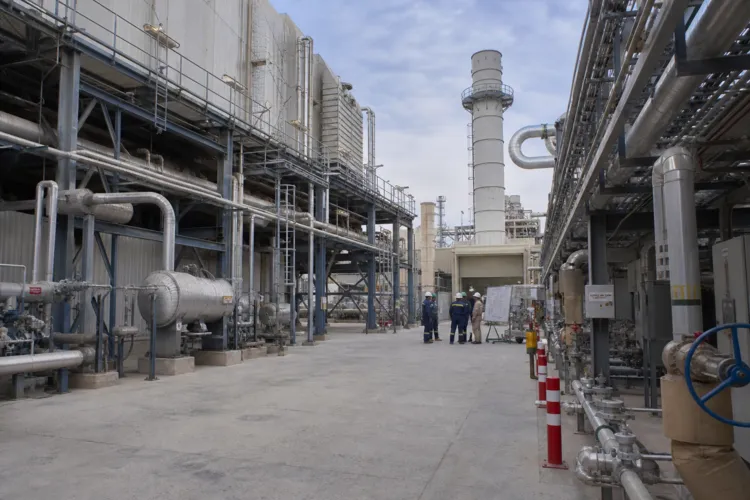
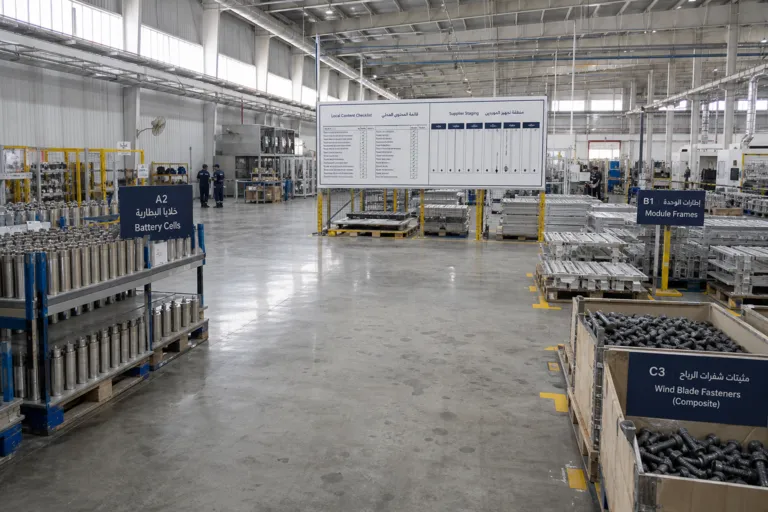
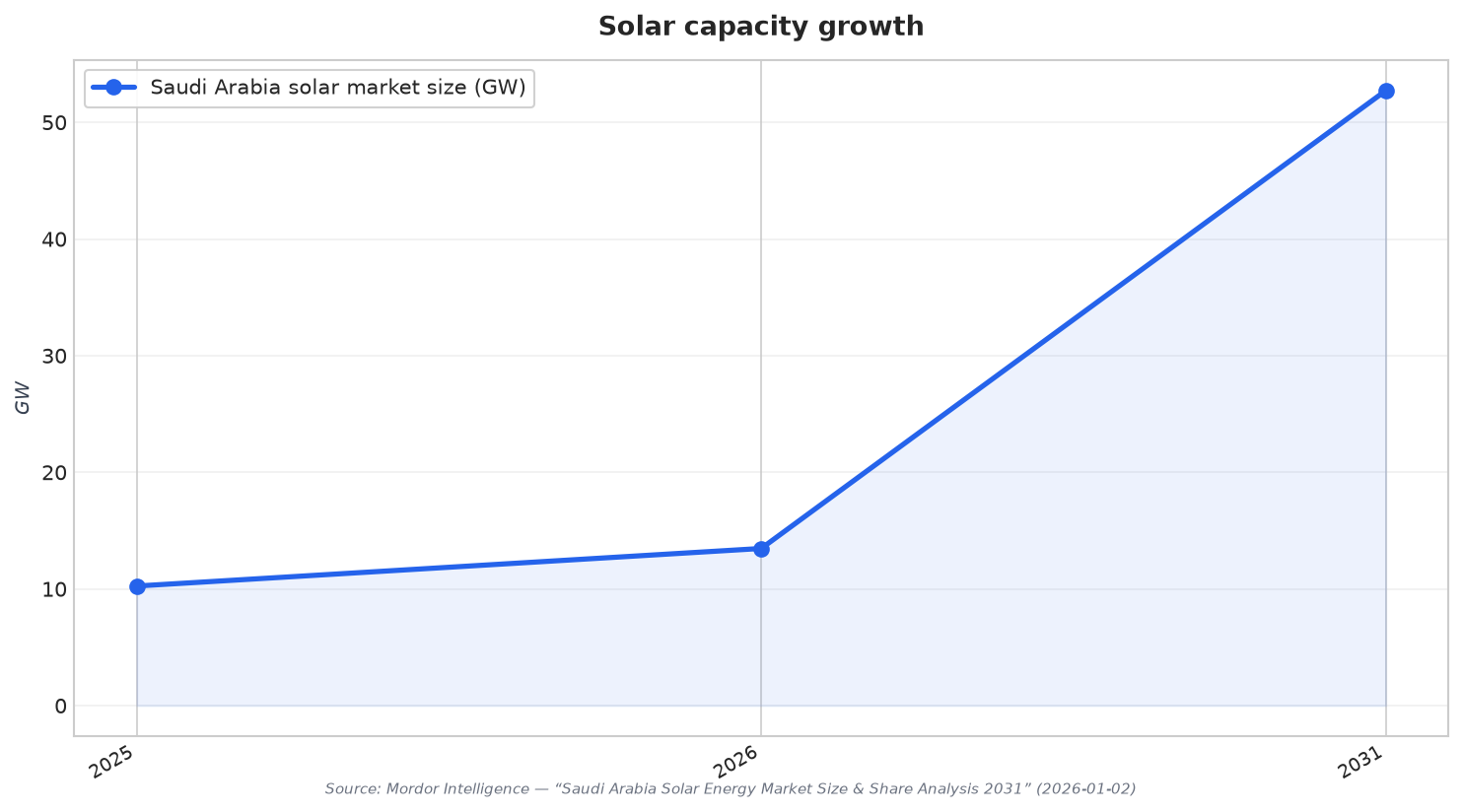
Saudi Arabia is moving quickly from clean-power deployment to industrial localization, and the policy signals are clear. Mordor Intelligence estimates the Saudi Arabia renewable energy market at 15.06 GW in 2026, up from 10.90 GW in 2025, with a 2031 projection of 75.68 GW and a 38.12% CAGR for 2026–2031. In solar specifically, Mordor estimates 13.47 GW in 2026, up from 10.25 GW in 2025, with a 2031 projection of 52.72 GW and a 31.40% CAGR for 2026–2031. This growth is anchored in Vision 2030 mandates and the National Renewable Energy Program (NREP), which Mordor describes as having a 130 GW procurement pipeline, alongside “ambitious local-content mandates” that are meant to pull manufacturing into the Kingdom.
Competitive pricing helps explain why localization can scale with the buildout. Mordor reports cost-competitive solar tariffs averaging USD 0.018/kWh, and also notes record-low tariffs below USD 0.018/kWh in NREP rounds. In Saudi Arabia’s solar market coverage, Mordor adds that over 3.3 GW was awarded in the latest rounds at an average tariff of 1.97¢/kWh, with winning bids dipping to 1.67 c/kWh. At the same time, procurement design is evolving: Mordor states that utility procurements now embed battery storage and local-content thresholds, aligning climate goals with industrial policy and “driving domestic manufacturing.” In other words, pricing momentum and tender structure are being used together to turn project volume into factory volume.
Localization Signals: Solar Dominance, Wind Acceleration, and Storage Pull-Through
The technology mix also points to where manufacturing demand concentrates. In the Saudi Arabian renewable energy market, Mordor says solar leads with a 93.15% share in 2025, while wind is projected to advance at an 81.7% CAGR through 2031. In the Saudi solar market breakdown, solar PV held 98.55% share in 2025, while concentrated solar power (CSP) is projected to expand at a 44.3% CAGR to 2031. Grid connection trends matter for equipment supply chains too: on-grid systems had an 89.85% share in 2025, with off-grid advancing at a 36.1% CAGR through 2031. End-use is diversifying beyond utilities, as Mordor projects commercial and industrial (C&I) solar installations to expand at a 38.9% CAGR to 2031, and C&I renewables at a 43.2% CAGR through 2031.
Several recent initiatives underline the industrial direction behind this expansion. A July 2024 report states the Public Investment Fund (PIF) signed three new agreements to localize the manufacturing and assembly of solar and wind generating equipment and components in Saudi Arabia. That same report says the Ministry of Energy launched a geographic survey in June 2024 that installed 1,200 measurement stations across 850,000 square kilometers to identify optimal locations for solar development—an upstream step that supports a deeper project pipeline. It also notes a “40% drop in battery prices in 2024” improving project economics, which can make solar-plus-storage procurement more attractive when tenders already embed batteries and local-content thresholds. These are the building blocks for a clean energy manufacturing hub Saudi Arabia is trying to create.
Demand growth and system constraints add another layer to localization. Mordor’s power-market analysis says renewables were 6.5 GW, or 6.8%, of installed capacity in 2024 and are forecast to exceed 40 GW by 2030, lifting their share to more than one-quarter within the outlook period. The same source projects the overall installed base grows from 100.60 GW in 2025 to 147.45 GW by 2030. It adds that commercial and industrial electricity consumption rises at an 11.5% CAGR between 2025 and 2030, and that large consumers increasingly contract directly for solar-plus-storage. Meanwhile, Mordor flags operational issues that manufacturers and developers must design around, including dust-driven PV efficiency losses of 15–20% annually and grid congestion in high-solar regions. Localization, then, is not just about volume; it is also about adapting hardware and services to Saudi operating realities.
What is driving Saudi Arabia toward localized clean-energy manufacturing?
How large is Saudi Arabia’s solar market expected to be in the next few years?
What do the sources say about wind growth in Saudi Arabia?
How are auctions and local-content rules changing under the NREP?
What does it mean for Saudi Arabia to become a clean-energy manufacturing hub?
Talk to us for your needs in:
-
Energy Efficiency Strategy & Feasibility
-
Renewable Energy Strategy & Investment Advisory
-
Digital Energy & Smart Grid Strategy
-
Market Entry Strategy
-
Sustainability & Impact Strategy
-
Energy Project Governance & PMO Advisory
-
Energy Market Research
-
Energy Stakeholder & Customer Research
-
Energy Market Intelligence
-
Energy Feasibility & Investment Assessment
-
Energy Sector Benchmarking & Performance Strategy