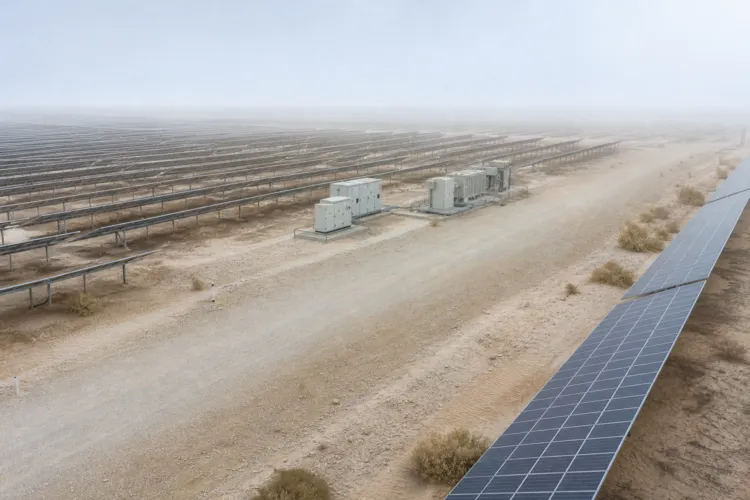
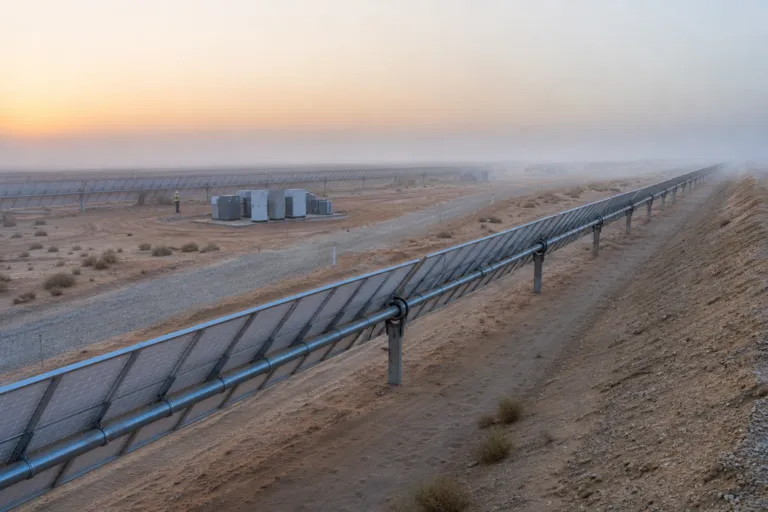
Single-axis solar trackers are motorized mounting systems that rotate PV panels on one axis to follow the sun’s path. In Saudi Arabia’s desert project environment, that simple concept maps directly to a developer goal: more annual yield per installed watt than fixed-tilt layouts. IndexBox describes the Middle East tracker segment as driven by the need to maximize energy yield from utility-scale PV plants, and cites that trackers can boost annual energy generation by 25–35% compared to fixed-tilt systems. Other sources frame the uplift more broadly as 15–35% versus fixed tilt, which is consistent with the idea that site conditions and design choices shape the final gain.
For regional context, IndexBox values the Middle East single-axis solar tracker market at about USD 1.2–1.5 billion in 2026 at the hardware-and-software system level, excluding module costs. It also estimates annual installed capacity at 8–11 GWdc, with tracker-attached capacity growing at a 14–18% CAGR through 2030, then moderating to 9–12% CAGR from 2031 to 2035. Those figures are regional rather than Saudi-specific, but they help explain why developers, EPCs, and suppliers treat tracking as a default for many new utility-scale builds across sun-rich desert terrain.
What Desert Projects Buy: HSAT Dominance, Costs, and Supply Chain Reality
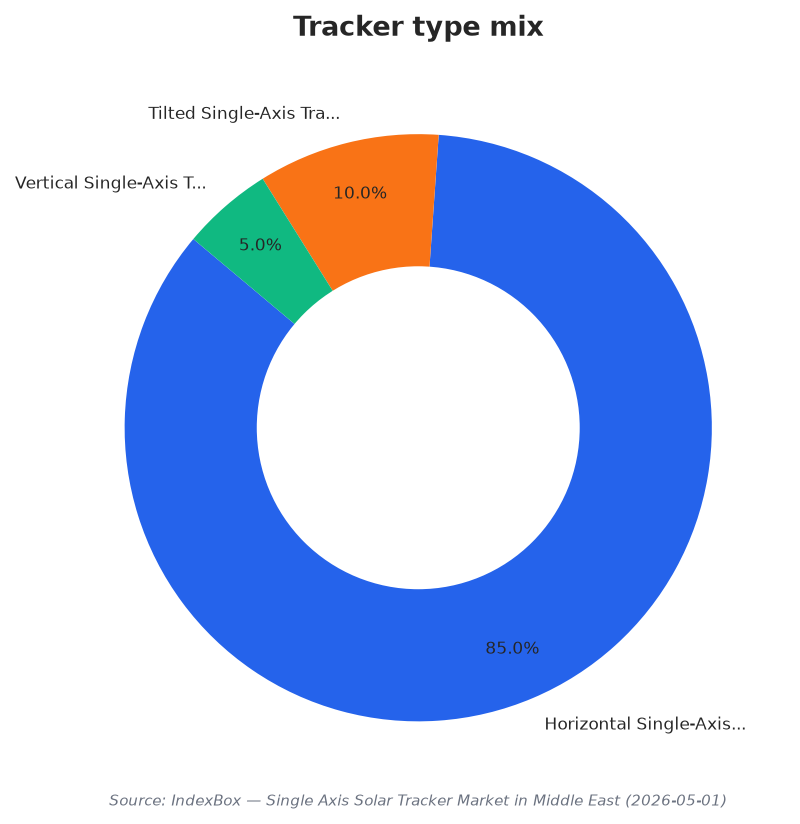
In the Middle East market mix, Horizontal Single-Axis Trackers (HSAT) dominate, accounting for over 85% of demand by volume, according to IndexBox. Tilted Single-Axis Trackers (TSAT) are roughly 10%, while Vertical Single-Axis Trackers (VSAT) are below 5% and limited to niche cases. On cost structure, IndexBox puts system-level pricing for single-axis trackers in the Middle East at USD 0.08–0.12 per Wp for hardware, software, and basic engineering, with total installed costs reaching USD 0.14–0.20/Wp once logistics, installation labor, and commissioning are included. The hardware bill of materials is led by steel at 40–50% of hardware cost, followed by electromechanical drives and controllers at 25–30%, and control software at 8–12%.
Supply chain exposure matters in Saudi procurement plans. IndexBox describes the Middle East tracker market as structurally import-dependent, with over 70% of tracker hardware by value sourced from outside the region. It adds that steel tubulars for torque tubes and pile foundations are imported from China, Turkey, and Europe, while regional processing is limited to steps such as cutting, welding, and galvanizing in Saudi Arabia and the UAE. At the same time, there are signals of local capability expansion: Grand View Research notes that in 2025, TrinaTracker established a new 3 GW solar tracker manufacturing facility in Saudi Arabia to strengthen local renewable energy infrastructure and support growing deployment across the Middle East and Africa.
Technology positioning is also shifting from “metal-only” structures to software-supported performance and uptime. IndexBox highlights a competitive landscape where global pure-play tracker OEMs such as Nextracker, Array Technologies, and Soltec together hold a combined 50–60% market share in the Middle East, leveraging technology IP in stow algorithms and predictive maintenance software. In that sense, modern solar tracker technology in Saudi Arabia is not just about rotating rows; it is also about controls that protect equipment and improve availability. IndexBox’s wider global renewable context also notes that solar power led new electricity generation additions in 2025, adding 510 GW and pushing total global renewable capacity beyond 5,000 gigawatts, reinforcing why yield-improving balance-of-system choices like trackers are gaining attention.
How much more energy can single-axis trackers deliver than fixed-tilt in the Middle East context?
Which single-axis tracker design is most common for desert utility PV in the Middle East?
What do single-axis tracker systems cost in the Middle East, all-in?
How import-dependent is the Middle East single-axis tracker supply chain, including Saudi Arabia?
What does “solar tracker technology” in Saudi Arabia include beyond the mechanical structure?
Talk to us for your needs in:
-
Energy Efficiency Strategy & Feasibility
-
Renewable Energy Strategy & Investment Advisory
-
Digital Energy & Smart Grid Strategy
-
Market Entry Strategy
-
Sustainability & Impact Strategy
-
Energy Project Governance & PMO Advisory
-
Energy Market Research
-
Energy Stakeholder & Customer Research
-
Energy Market Intelligence
-
Energy Feasibility & Investment Assessment
-
Energy Sector Benchmarking & Performance Strategy