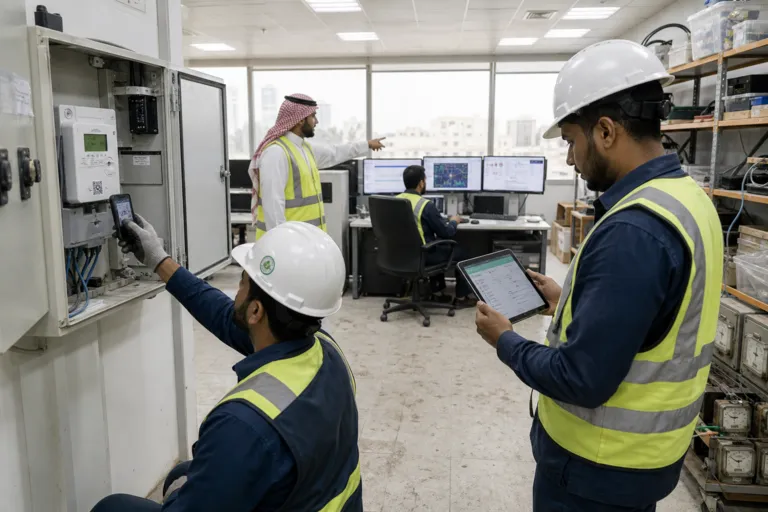
Saudi Arabia’s smart metering push is becoming a defining feature of its digital grid modernization agenda. Multiple market outlooks tie this shift to large-scale replacement of legacy meters, grid modernization investments, and policies that make metering upgrades mandatory. Mobility Foresights projects the Saudi Arabia residential electric meter market to grow from USD 3.2 billion in 2025 to USD 5.4 billion by 2032, at a CAGR of 7.8% over the 2026–2032 study period. In this framing, residential meters are no longer just billing devices. They are positioned as “smart grid edge devices” that support real-time data exchange, monitoring, and utility operations.
Market drivers in the sources connect metering demand to both infrastructure and technology. Mobility Foresights highlights growth in residential electricity connections and housing construction as a direct driver of new meter installations. It also notes that distributed energy resources, including rooftop solar and home battery storage systems, increase demand for advanced bidirectional metering capability. On the utility side, improvements in wireless communication technology and meter data analytics platforms are described as enhancing overall system value and accelerating adoption decisions. Together, these factors shape how the smart meter rollout in Saudi Arabia is treated as an enabler of grid management rather than a narrow hardware refresh.
From Devices to Networks: AMI Needs a Digital Backbone
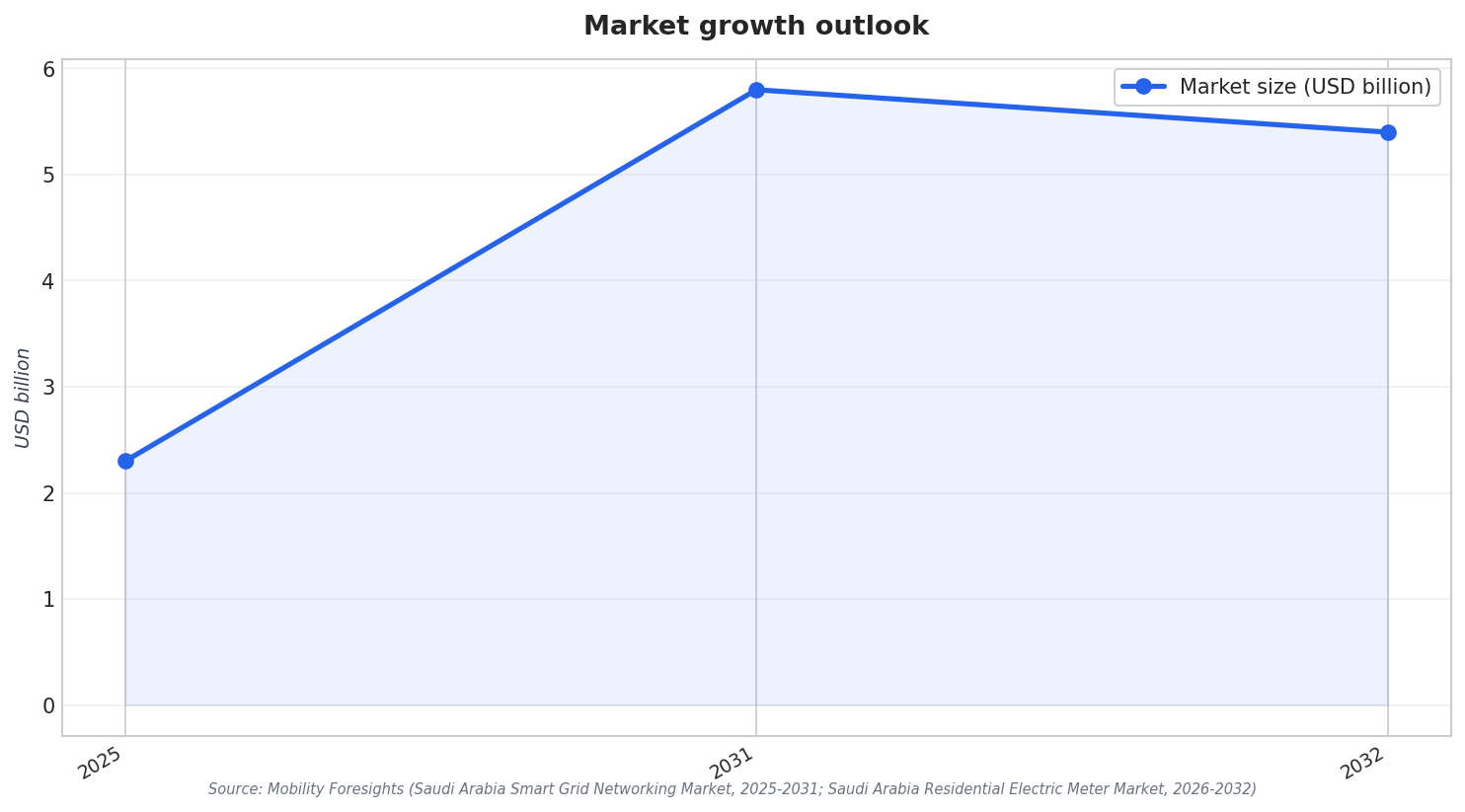
Scaling advanced metering infrastructure (AMI) also depends on the communications layer that connects meters to control centers. Mobility Foresights forecasts the Saudi Arabia smart grid networking market to rise from USD 2.3 billion in 2025 to USD 5.8 billion by 2031, representing a CAGR of 16.5% across 2025–2031. The same source links this growth to investments in grid automation, digital communication technologies, and AMI, with utilities adopting high-speed platforms for real-time fault detection, demand response, and intelligent load management. It also describes multiple network options—RF mesh, fiber-optic, PLC, and cellular—and points to secure networking protocols as part of resilience efforts.
Saudi Arabia’s broader smart grid and distributed energy momentum reinforces why metering is being deployed at scale. Ken Research values the Saudi Arabia Smart Grid & Distributed Energy Market at approximately USD 8.5 billion, based on a five-year historical analysis, and cites energy efficiency needs, renewable energy integration, and government modernization initiatives. In that context, it states that demand for smart metering solutions is expected to rise significantly, with an estimated 5 million smart meters projected to be installed by 2025. A separate market outlook from Market Publishers expects the Saudi Arabian smart meters market to grow at 11.14% during 2025–2033, attributing growth to increasing energy demand, Vision 2030-related government requirements, renewable integration, and grid modernization.
As deployments expand, analytics and governance become more visible in the sources. HTF Market Insights projects the Middle East smart grid analytics market to grow from USD 1.2 billion in 2025 to USD 3.8 billion by 2034, at a CAGR of 13.5%, and notes that Saudi Arabia leads the regional market in size due to grid modernization initiatives and government investments in smart infrastructure. It also states that Advanced Metering Infrastructure dominates the product segment by share, while Energy Management Systems show the highest growth rates driven by real-time optimization needs. The same source adds that Saudi Arabia’s Electricity & Cogeneration Regulatory Authority introduced mandates requiring smart metering rollout and data transparency for utilities, underscoring how policy and data practices can shape outcomes alongside technology.
What is driving the smart meter rollout in Saudi Arabia?
How large is Saudi Arabia’s residential electric meter market expected to become?
How many smart meters are projected to be installed in Saudi Arabia by 2025?
Why does smart grid networking matter for AMI scale in Saudi Arabia?
What do the sources say about analytics and regulation supporting smart meters in Saudi Arabia?
Talk to us for your needs in:
-
Energy Efficiency Strategy & Feasibility
-
Renewable Energy Strategy & Investment Advisory
-
Digital Energy & Smart Grid Strategy
-
Market Entry Strategy
-
Sustainability & Impact Strategy
-
Energy Project Governance & PMO Advisory
-
Energy Market Research
-
Energy Stakeholder & Customer Research
-
Energy Market Intelligence
-
Energy Feasibility & Investment Assessment
-
Energy Sector Benchmarking & Performance Strategy