AI is becoming central to upstream decision-making at Saudi Aramco, especially where subsurface uncertainty drives cost and risk. In its description of industrial AI, Aramco says AI can integrate seismic data, sensor readings, and subsurface models in real time to create continuously updating digital Earth models as drilling progresses. Aramco adds that when these dynamic models are combined with machine learning trained on historical field data, teams can generate predictive well logs and estimate critical reservoir properties with greater speed and accuracy. This framing puts AI reservoir management at Saudi Aramco in the context of real-time data fusion, rather than a standalone software layer.
That subsurface visibility is positioned as an operational advantage, not just a modeling improvement. Aramco says enhanced visibility helps engineers better understand complex geology, maximize reservoir contact, reduce uncertainty, and execute field operations more effectively. It also links this to improving resource recovery while optimizing the use of physical logging tools. In parallel, a profile of Aramco Digital notes that upstream AI models analyze seismic data to identify prospective drilling locations with greater accuracy and speed than traditional geological interpretation methods. The same source says machine learning algorithms process historical production data to optimize well performance, predict equipment failures, and manage reservoir depletion rates.
From Seismic Interpretation to Reservoir Optimization Workflows
Aramco also describes how AI extends from interpretation into execution. Across upstream operations, it says AI enhances seismic interpretation, subsurface modeling, well placement, and drilling performance, giving geoscientists and engineers deeper visibility into complex geology. The goal is faster responses to changing conditions and more adaptive decisions during drilling and field operations. External reporting on a Microsoft framework for Aramco similarly describes reservoir optimization as applying AI to seismic data and production history to improve the yield and longevity of oil and gas fields. The same framework highlights predictive maintenance that uses historical sensor data and machine learning to forecast equipment failures before they occur.
At scale, the capability depends on people and deployment, not only algorithms. A market analysis notes that only 15% of reservoir engineers actively apply machine-learning methods, illustrating a narrow talent base. The same source states that Aramco has trained 6,000 AI developers as part of its METABRAIN initiative, and also references a March 2025 deployment of comprehensive AI systems, including a partnership with Qualcomm on generative-AI inferencing centers. This matters for reservoir work because many workflows blend geoscience, engineering, and data science, and adoption can be constrained when domain teams cannot operationalize models consistently.
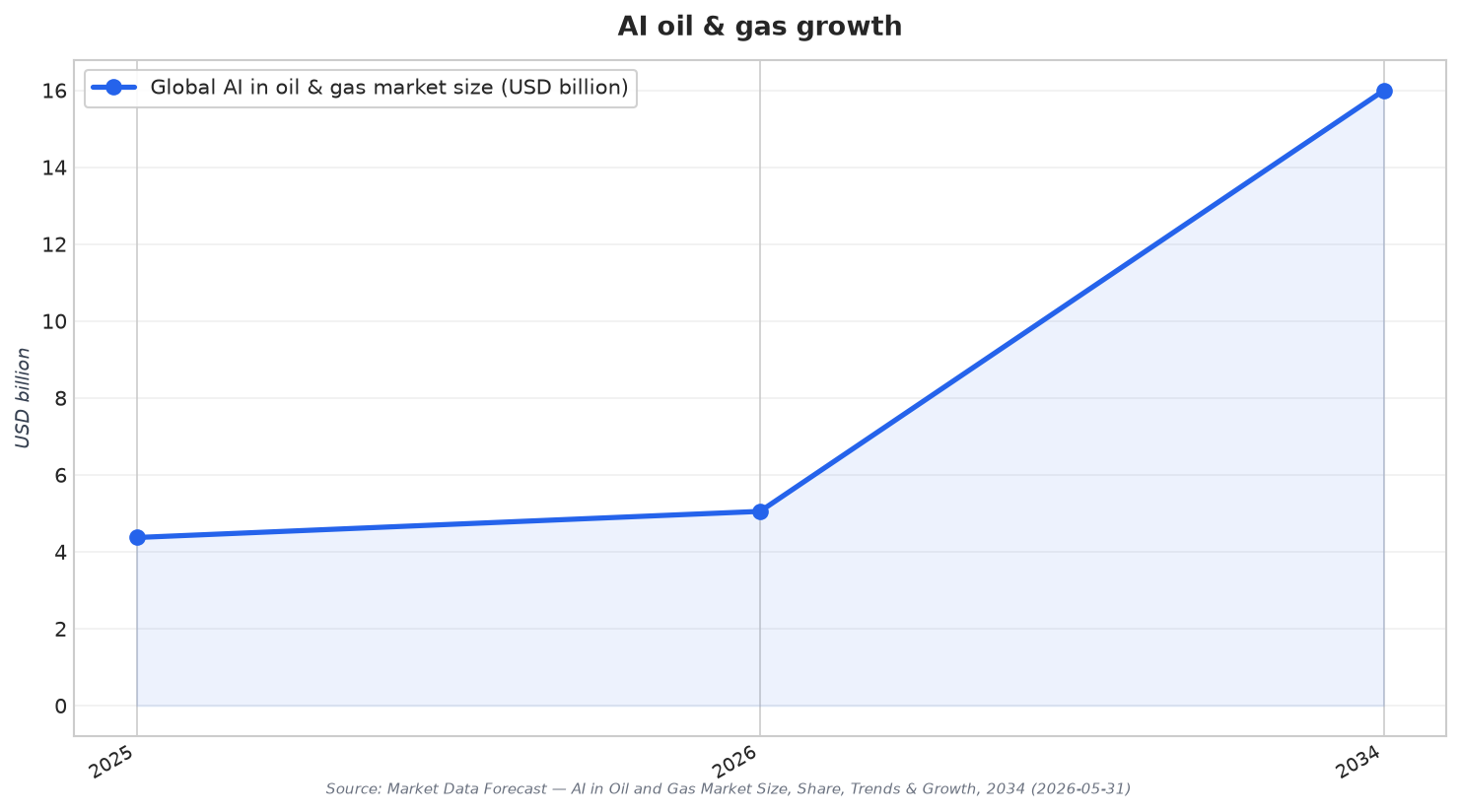
Aramco’s upstream AI push sits inside a broader industry shift toward machine learning as a dominant technique. One market forecast values the global AI in oil and gas market at USD 4.37 billion in 2025, estimates USD 5.05 billion in 2026, and projects USD 15.99 billion by 2034, with a 15.55% CAGR from 2026 to 2034. The same forecast says machine learning accounts for a 58.7% share and that upstream captures 49.3% of market share, while another industry report states upstream activities contributed 61.05% to market size in 2025. Together, these figures provide context for why Saudi Aramco emphasizes AI-enabled subsurface modeling, well placement, and production optimization as core levers for reservoir performance.
How does Saudi Aramco use AI to build digital Earth models during drilling?
What data sources are used in Aramco’s reservoir optimization approach?
What does the industry say about machine-learning adoption among reservoir engineers?
How does AI reservoir management at Saudi Aramco connect to well placement and drilling performance?
Talk to us for your needs in:
-
Energy Efficiency Strategy & Feasibility
-
Renewable Energy Strategy & Investment Advisory
-
Digital Energy & Smart Grid Strategy
-
Market Entry Strategy
-
Sustainability & Impact Strategy
-
Energy Project Governance & PMO Advisory
-
Energy Market Research
-
Energy Stakeholder & Customer Research
-
Energy Market Intelligence
-
Energy Feasibility & Investment Assessment
-
Energy Sector Benchmarking & Performance Strategy