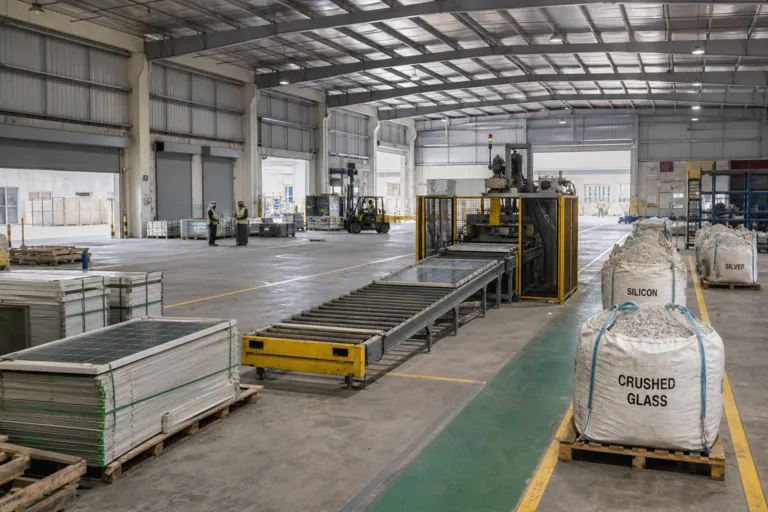
Solar panel recycling in Saudi Arabia is best understood as a circular supply-chain challenge, not a single end-of-life service. One Saudi-focused market study defines PV recycling as the process of collecting, disassembling, and recovering valuable materials such as glass, aluminum, silicon, silver, and copper from end-of-life photovoltaic panels, while ensuring environmentally sound management and enabling circular economy principles. The same study frames the market through buyer environments, upstream input dependencies, conversion steps, safety and qualification requirements, pricing architecture, and commercial channels, rather than a narrow product category. That structure matters because a circular PV supply chain depends on what can be recovered, how it is qualified, and how it can re-enter manufacturing or other downstream uses.
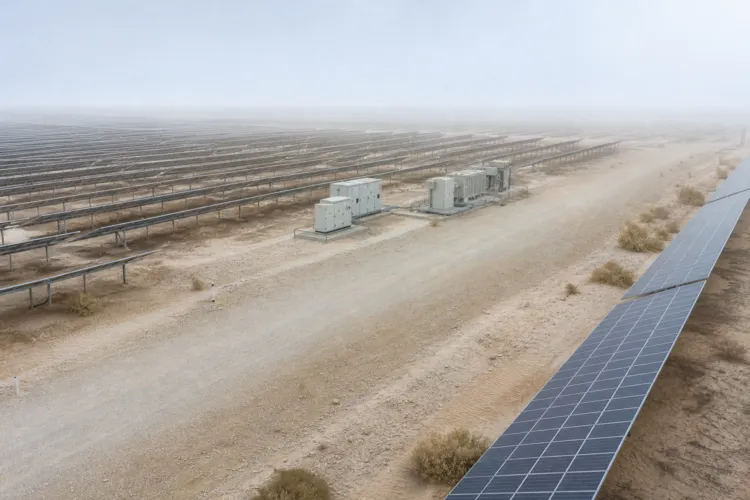
Planning is becoming more concrete because Saudi Arabia is adding solar capacity, which ultimately creates future panel waste streams. A reverse logistics study notes that Saudi Arabia is heavily investing in large-scale solar PV plants and that, as of 2022, 390 MW of solar PV generation capacity had been installed. The same paper designs a reverse logistics network for waste solar PV panels expected in 2043, using a mixed-integer programming optimization model to minimize total network cost. It also builds a 24 (solar plant) × 24 (recycling center) distance matrix as an input, highlighting that logistics choices and facility placement are central to making recycling workable at scale. In a KSA context, the authors link this planning approach to the opportunity for an in-country circular economy that can support local content aspirations.
From Reverse Logistics to High-Value Material Recovery
Recycling economics are anchored in what panels are made of and what a recycler can extract reliably. A 2026 industry outlook states that over 80% of a solar panel’s weight consists of silicon and various metals, and argues that recovering these materials is economically viable while contributing to resource conservation and circular economy goals. Global market commentary also emphasizes material recovery performance: one market source describes a closed-loop system that recovers over 90% of key materials, including semiconductor compounds and glass. Another describes innovations aimed at extracting high-purity silicon, silver, and copper from crystalline silicon panels. For Saudi Arabia, these figures should be treated as global context, but they help clarify what a circular PV supply chain is trying to achieve: consistent, high-quality outputs that downstream buyers can trust.
Global market forecasts further show how fast recycling is becoming an organized industry, offering useful comparison points as Saudi Arabia builds capability. One forecast projects the solar panel recycling market to reach USD 1.12 billion by 2030. Another global forecast values the market at USD 348.9 million in 2025 and projects USD 691.6 million by the end of 2035, rising at a CAGR of 7.9% during 2026–2035; it also predicts Europe will account for a 38.5% share by 2035, which it links to stringent recycling regulations and established infrastructure. These numbers are not Saudi-specific, but they reinforce a key strategic lesson for the Kingdom: regulation, logistics design, and credible processing capacity tend to move together as recycling markets mature.
To turn planning into execution, Saudi Arabia can align market definition, reverse logistics, and offtake for recovered materials into one operating model. The Saudi market study explicitly covers deployment use cases, project economics, competitive structure, and safety requirements, and it typically analyzes 2012 to 2025 with scenarios through 2035. The reverse logistics study shows how networks can be optimized for a future year (2043) and built around distances between generating sites and recycling centers. When these approaches are combined, they outline a circular PV supply chain roadmap: set clear boundaries for what counts as recycling, design collection and transport flows, and qualify recovered glass, aluminum, silicon, silver, and copper so they can re-enter domestic and regional value chains rather than becoming managed waste.
What does solar panel recycling mean in the Saudi Arabia context?
How much solar PV capacity had Saudi Arabia installed by 2022?
How can Saudi Arabia plan a recycling network for future PV waste?
What material factors make PV recycling economically relevant?
Which global figures help benchmark recycling market momentum?
Talk to us for your needs in:
-
Energy Efficiency Strategy & Feasibility
-
Renewable Energy Strategy & Investment Advisory
-
Digital Energy & Smart Grid Strategy
-
Market Entry Strategy
-
Sustainability & Impact Strategy
-
Energy Project Governance & PMO Advisory
-
Energy Market Research
-
Energy Stakeholder & Customer Research
-
Energy Market Intelligence
-
Energy Feasibility & Investment Assessment
-
Energy Sector Benchmarking & Performance Strategy