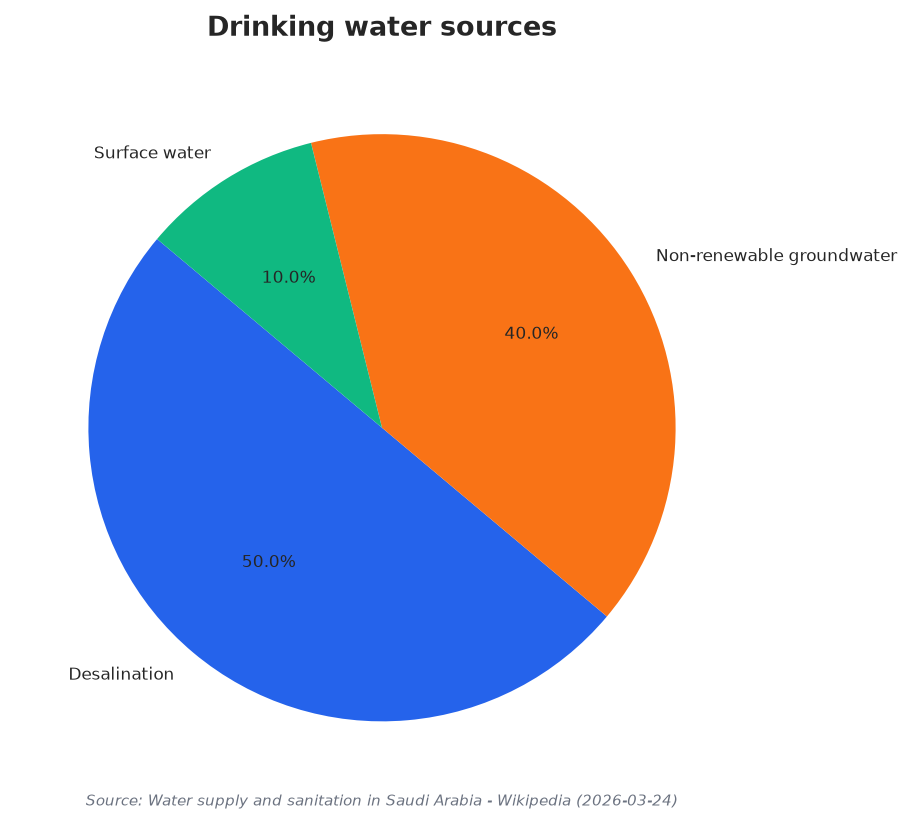
Saudi Arabia’s water-security story is also an energy story. The country’s drinking water supply relies heavily on desalination: about 50% of drinking water comes from desalination, 40% from mining non-renewable groundwater, and 10% from surface water in the mountainous southwest. This dependence turns every kilowatt-hour into a water issue, especially when long-distance transport is involved. Riyadh, located in the heart of the country, is supplied with desalinated water pumped from the Persian Gulf over a distance of 467 km. In parallel, Saudi desalination and water transmission consume approximately 20% of Saudi Arabia’s electricity production, making the sector one of the Kingdom’s largest energy consumers.
This pressure sits inside a broader “water-energy nexus,” where energy is consumed to extract, purify, deliver, treat, and dispose of water and wastewater. In the Gulf Cooperation Council (GCC), where water scarcity is extreme, desalination is described as one of the highest energy-demanding industrial processes, and the region relies on it for the majority of freshwater supply. Energy Intelligence notes an International Energy Agency expectation that energy demand for water desalination is expected to double by 2030 (global outlook). For Saudi Arabia, the practical implication is direct: if desalination is essential for water, then lowering its electricity intensity is essential for managing the national power bill and supporting long-term sustainability goals such as the Saudi Green Initiative’s ambition to reach net zero emissions by 2060.
Where the Biggest Efficiency Gains Can Come From
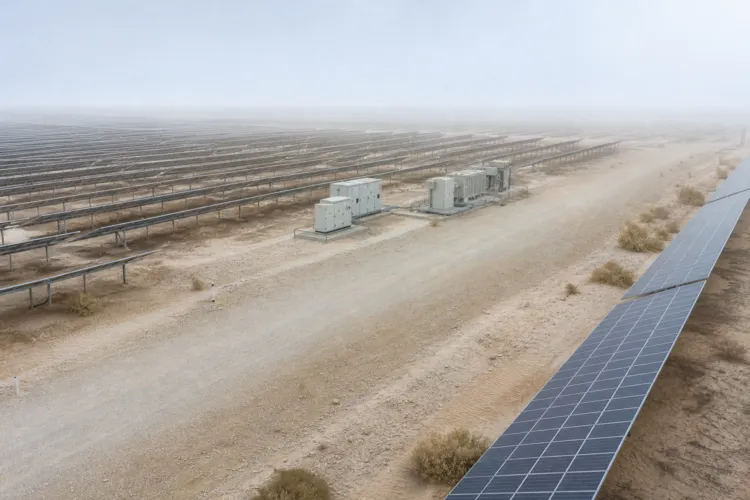
Technology choices shape the power footprint. Reverse osmosis (RO) desalination uses high-pressure membranes and is an electrically driven process, which makes it highly compatible with solar PV systems compared with thermal approaches such as MSF. Across the GCC, solar-powered RO plants are being deployed at increasing scale, and Saudi Arabia’s NEOM project “envisions a city powered entirely by renewable energy, with desalination needs met through solar-driven systems.” On the component side, continuous improvements in RO membrane technology—higher permeability, greater salt rejection, longer membrane life, and reduced fouling—are explicitly linked to further reductions in desalination costs and energy consumption, with Saudi institutions including KAUST conducting membrane research. This is the engineering core of desalination energy efficiency in Saudi Arabia: less energy per unit of water, plus cleaner electricity inputs.
Efficiency is also financial and institutional. Since 2000, the Saudi government has increasingly relied on the private sector to operate water and sanitation infrastructure, starting with desalination and wastewater treatment plants. The National Water Company (NWC) was created in 2008, and the operation of urban water distribution systems in the four largest cities has gradually been delegated to private companies. Wikipedia describes a subsidy structure where the government buys desalinated water from private operators at high prices and resells bulk water for free, while also paying operators under management contracts and subsidizing investments. Tariff reform has been politically sensitive: in January 2016, water and sewer tariffs were increased for the first time in more than a decade, leading to discontent and the sacking of the Minister of Water and Energy in April 2016.
Finally, demand shape matters as much as supply. Total water demand in Saudi Arabia is approximately 20 billion cubic meters annually, split among municipal use (approximately 50%), agriculture (approximately 40%), and industrial use (approximately 10%). The same source links groundwater depletion to increasing reliance on desalination for potable supply and to restricting groundwater-intensive agriculture, including the phase-out of domestic wheat cultivation. For planners, this mix clarifies where water savings can reduce future desalination loads and their electricity needs. The Middle East desalination plants market source also frames Saudi Arabia as leading the regional market at 36%, reflecting investments and strategies aimed at water security, with an emerging trend of integrating renewable energy—particularly solar—into desalination operations to reduce costs and carbon emissions.
Why is desalination so important to Saudi Arabia’s drinking water supply?
How big is the power impact of Saudi desalination and water transmission?
What does Riyadh’s water supply reveal about the water-energy nexus?
How can desalination energy efficiency in Saudi Arabia improve without sacrificing water security?
How is demand distributed across Saudi Arabia’s water users?
Talk to us for your needs in:
-
Energy Efficiency Strategy & Feasibility
-
Renewable Energy Strategy & Investment Advisory
-
Digital Energy & Smart Grid Strategy
-
Market Entry Strategy
-
Sustainability & Impact Strategy
-
Energy Project Governance & PMO Advisory
-
Energy Market Research
-
Energy Stakeholder & Customer Research
-
Energy Market Intelligence
-
Energy Feasibility & Investment Assessment
-
Energy Sector Benchmarking & Performance Strategy