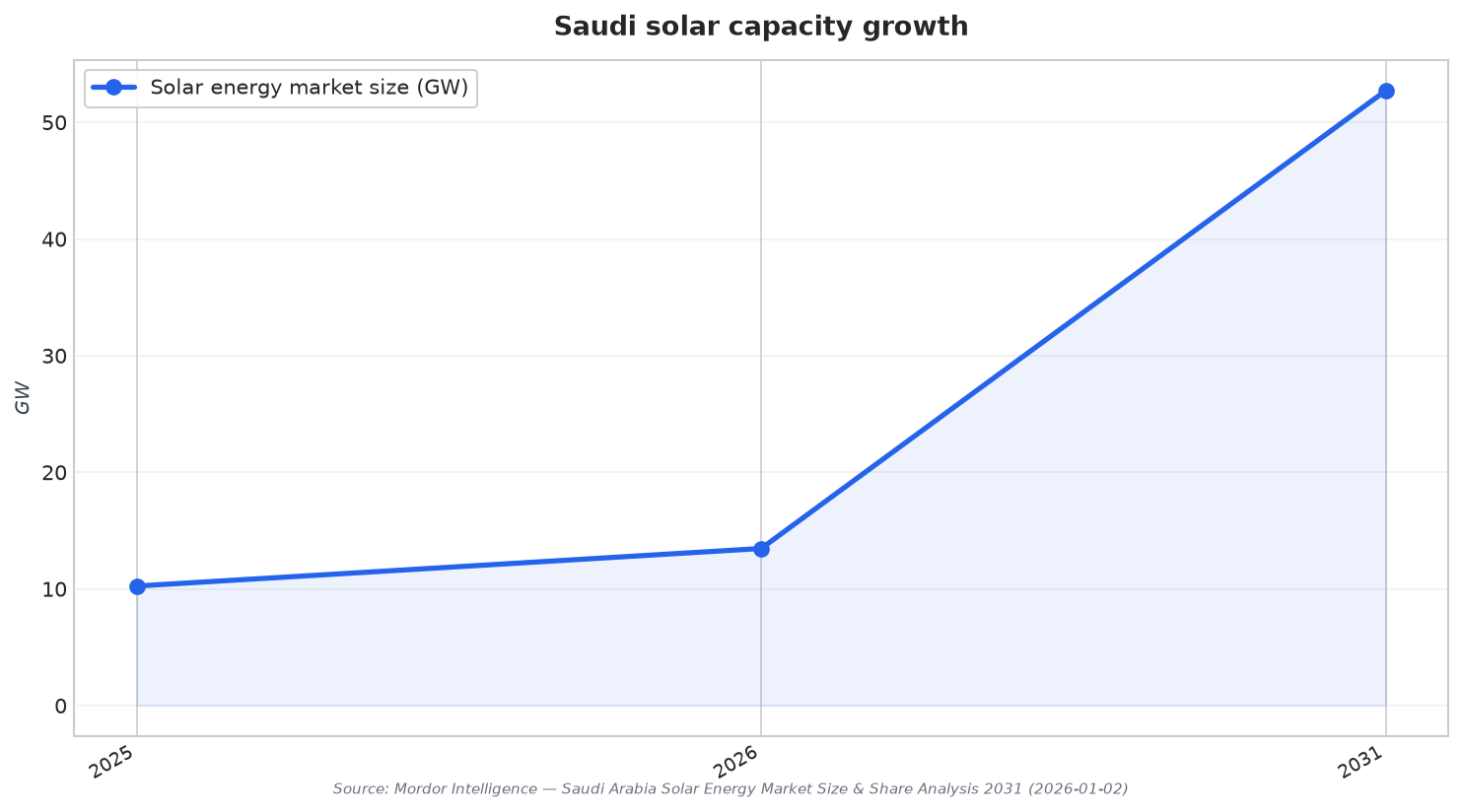
Saudi Arabia’s solar buildout is scaling fast, and utility tenders are the center of gravity. Mordor Intelligence estimates the Saudi Arabia solar energy market at 13.47 GW in 2026, up from 10.25 GW in 2025, with projections reaching 52.72 GW by 2031, at a 31.40% CAGR for 2026–2031. Solar PV dominated with a 98.55% technology share in 2025, and utility-scale projects accounted for 65.05% of market size that year. This tender-heavy structure rewards proven equipment choices that can be financed, delivered, and operated at predictable performance in desert sites—conditions where bifacial modules and tracking systems are increasingly becoming the default bid configuration.
The performance case for bifacial PV is tightly linked to Saudi site conditions and how tenders are priced. IndexBox describes bifacial TOPCon and HJT modules as rapidly replacing PERC as the dominant technology in Saudi Arabia, citing higher energy yield in the region’s high-albedo desert conditions and efficiency gains of 1–2% annually. MarkWide Research also frames the wider regional context, noting that bifacial module technology is capturing growing share in high-albedo desert environments and that EPC contractors now specify dual-glass architectures for Saudi and UAE megaprojects. Put simply, when developers compete in auctions where every fraction of a cent matters, higher yield per installed system can translate into sharper bids without changing the project footprint.
Tender Economics Now Favor High-Yield, Low-Risk Architectures
Saudi procurement mechanics further amplify the advantage of bankable, high-output designs. Mordor Intelligence reports that REPDO’s multi-round auctions provide predictable timelines and uniform contract structures, while local-content rules increased from 15% to 35% between Round 1 and Round 6. It also states that over 3.3 GW was awarded in the latest rounds at an average tariff of 1.97¢/kWh, and that recent winning bids dipped to 1.67 c/kWh. In that context, the “winning” stack is the one that reduces uncertainty while lifting production. Mordor Intelligence also notes utility procurements now embed battery storage and local-content thresholds, reinforcing a preference for mature, standardized components and procurement pathways.
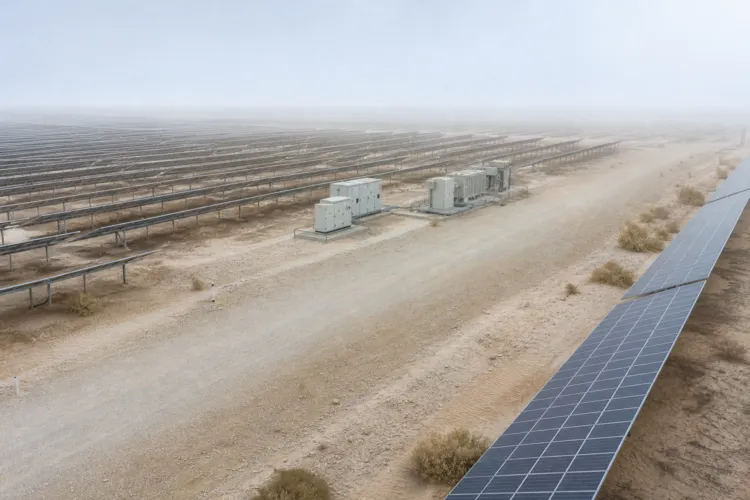
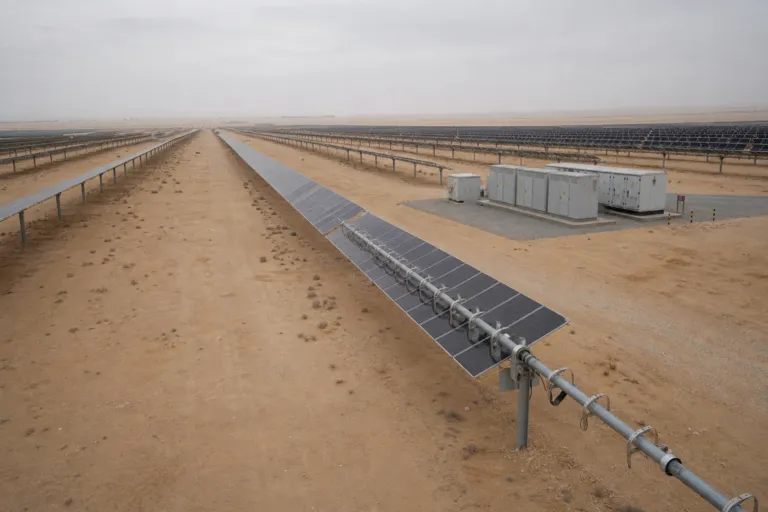
Trackers are the other half of the tender formula, because bifacial gains are easier to realize when arrays are optimized for daily sun capture and rear-side exposure. IndexBox reports that single-axis tracking systems are becoming standard for utility-scale projects, with over 80% of new ground-mount installations using trackers. The same source ties this to Saudi Arabia’s high direct normal irradiance (DNI) of 2,000–2,500 kWh/m²/year. Mordor Intelligence’s renewable energy market analysis likewise notes that bifacial modules and trackers lift yields across desert terrains, and adds that bifacial modules boost yields by 25–30% in its discussion of utility-scale PV competitiveness. Together, trackers plus bifacial modules help developers defend energy yield assumptions that underpin auction pricing and debt sizing.
Finally, tender wins also follow the supply-and-price realities of equipment buying in Saudi Arabia. IndexBox states that, in 2026, PV module prices for mainstream bifacial PERC modules (545–585 Wp) range from USD 0.08–0.12 per Wp, while TOPCon and HJT carry a USD 0.01–0.03/Wp premium due to higher efficiency (22–24%). It adds that large tenders (50 MW and above) are procured directly by developers and EPC contractors through competitive bidding, with volume discounts and long-term supply agreements. In practice, that combination—scale purchasing, standardized delivery, and desert-optimized yield—explains why bifacial solar technology in Saudi Arabia is increasingly positioned as the safest path to winning utility-scale tenders on price and performance.
How fast is Saudi Arabia’s solar market projected to grow through 2031?
Why do bifacial modules fit Saudi Arabia’s desert utility tenders?
What tender prices are being seen in Saudi Arabia’s REPDO auction rounds?
How common are single-axis trackers in new Saudi utility-scale solar builds?
What are 2026 PV module price ranges cited for Saudi Arabia?
Talk to us for your needs in:
-
Energy Efficiency Strategy & Feasibility
-
Renewable Energy Strategy & Investment Advisory
-
Digital Energy & Smart Grid Strategy
-
Market Entry Strategy
-
Sustainability & Impact Strategy
-
Energy Project Governance & PMO Advisory
-
Energy Market Research
-
Energy Stakeholder & Customer Research
-
Energy Market Intelligence
-
Energy Feasibility & Investment Assessment
-
Energy Sector Benchmarking & Performance Strategy