Wind turbine manufacturing in Saudi Arabia is becoming a practical discussion because wind deployment is forecast to grow and because supply chain localization is repeatedly cited as a priority. IMARC data referenced by Futurism puts the Saudi Arabia wind power market at USD 913.6 million in 2025 and forecasts USD 1,374.9 million by 2034, with a 4.65% CAGR during 2026–2034. Mobility Foresights also describes the Saudi Arabia Wind Energy Market rising from USD 92.4 billion in 2025 to USD 156.8 billion by 2031, a 9.2% CAGR. These forecasts are not a factory plan by themselves, but they help explain why developers, OEMs, and policymakers focus on building local capability.
The near-term opportunity is clearest where import dependence is explicit. IndexBox states that, as of 2026, Saudi Arabia has no domestic commercial-scale offshore wind blade manufacturing. The same source expects total installed offshore wind capacity to reach 1–2 GW by 2030, translating into about 60–120 blades assuming 8–10 MW turbines. It also notes that Siemens Gamesa Renewable Energy, Vestas, and GE Renewable Energy collectively supply 60–65% of blades for Saudi projects through turbine supply agreements, with blades manufactured outside the Kingdom in locations including Denmark, China, Spain, and France. For local supply chain builders, this points to the highest-friction items first: large composite blades, heavy logistics, and qualification processes.
How to Build a Local Wind Supply Chain Without Overreaching
Start where the system value can localize fastest, while planning for advanced components later. IndexBox’s Saudi hybrid solar-wind systems study describes an import-dependent model for high-value parts such as wind turbines, battery cells, grid-forming inverters, and advanced energy management systems. It estimates 2026 imports for this product category at USD 180–230 million. The report adds that 60–65% of system value is imported, but local content is rising by 2–3 percentage points annually as assembly and fabrication capabilities expand, while balance-of-system items like cables, mounting structures, low-voltage switchgear, and transformers are increasingly sourced locally. For wind projects, that suggests a staged path: expand local fabrication and assembly ecosystems first, then deepen into nacelle and blade manufacturing as volumes and skills mature.
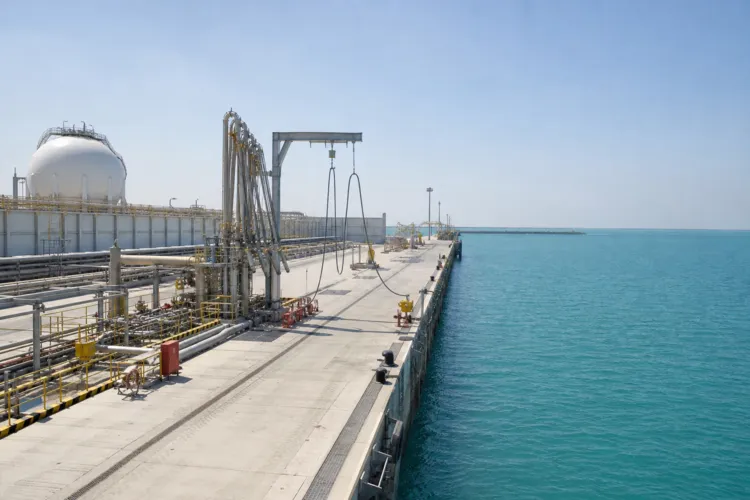
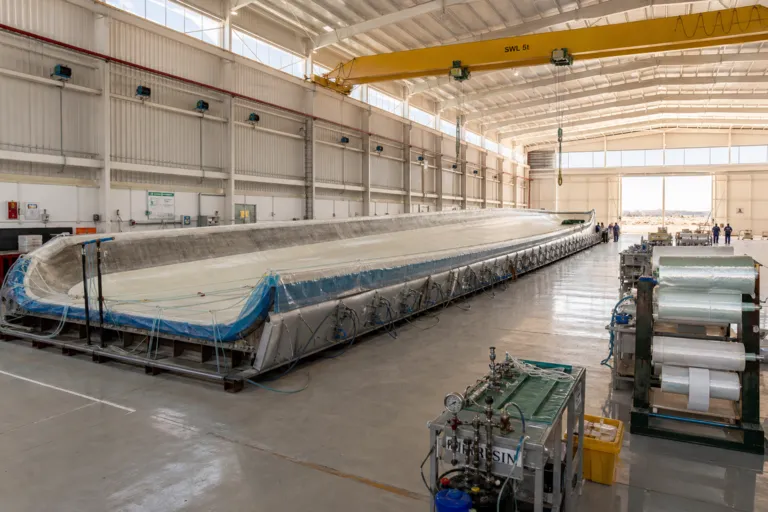
Blades are a useful lens for what “deep localization” entails. Mobility Foresights projects the Saudi Arabia Wind Turbine Blade Market growing from USD 24.8 billion in 2025 to USD 51.6 billion by 2032 at an 11.0% CAGR, and it highlights composite materials such as fiberglass and carbon fiber. It also flags material supply and cost volatility as a risk, since composite inputs may fluctuate and supply chain disruptions can affect timelines. IndexBox adds that port infrastructure gaps matter too, stating that major ports including Jeddah, Yanbu, and Ras Al Khair lack dedicated quayside space and heavy-lift cranes capable of handling 100m+ blades. Taken together, manufacturing readiness is not only about a factory; it also depends on ports, transport, and reliable composite supply.
Offshore components and services also shape local competitiveness beyond blades. Mobility Foresights projects the Saudi Arabia Offshore Wind Turbine Components Market growing from USD 42.3 billion in 2025 to USD 97.8 billion by 2032, a 12.9% CAGR, and links momentum to localized manufacturing and supply chain investments, partnerships, and supportive policies. It lists major offshore components such as blades, nacelles, towers, hubs, drivetrains, gearboxes, generators, yaw and pitch systems, and foundation structures including monopiles, jackets, and floating platforms. The same source connects rising demand to larger turbine sizes of 10+ MW and to digitalization and predictive maintenance. For Saudi Arabia, the most durable local supply chain strategy aligns manufacturing, logistics, and lifecycle services, so projects can be delivered and maintained with fewer external bottlenecks.
What is driving wind turbine manufacturing and supply chain localization in Saudi Arabia?
Does Saudi Arabia manufacture offshore wind turbine blades domestically today?
How much offshore capacity and blade demand could Saudi Arabia reach by 2030?
Which suppliers dominate blade supply for Saudi offshore projects?
What are practical early steps for wind turbine manufacturing in Saudi Arabia to localize content?
Talk to us for your needs in:
-
Energy Efficiency Strategy & Feasibility
-
Renewable Energy Strategy & Investment Advisory
-
Digital Energy & Smart Grid Strategy
-
Market Entry Strategy
-
Sustainability & Impact Strategy
-
Energy Project Governance & PMO Advisory
-
Energy Market Research
-
Energy Stakeholder & Customer Research
-
Energy Market Intelligence
-
Energy Feasibility & Investment Assessment
-
Energy Sector Benchmarking & Performance Strategy