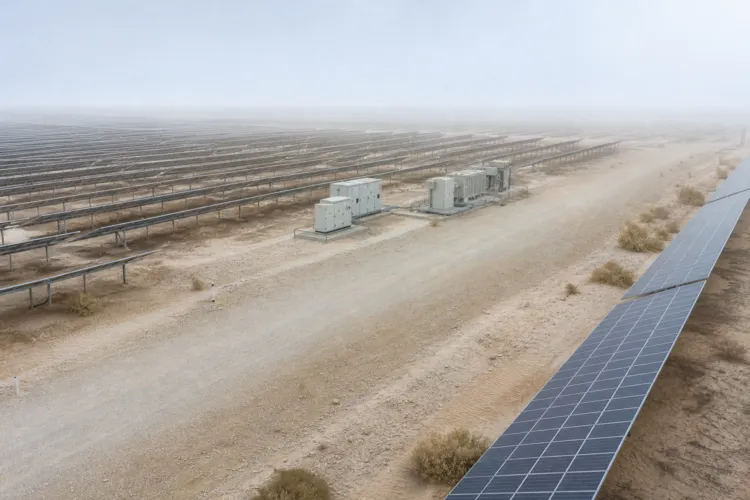
Saudi Arabia’s Vision 2030 targets 40 GW of solar PV capacity by 2030, supported by solar irradiation that averages over 2,200 kWh per square meter annually. But desert operation is not a standard PV environment. The two recurring constraints are persistent soiling from dust and sand, and extreme heat. Research cited for desert regions indicates soiling can cause daily power loss of up to 1%, and without rain or cleaning, the impact accumulates. In parallel, modules are rated at 25°C, yet Saudi ambient temperatures can exceed 50°C, pushing module operating temperatures much higher and creating performance drag that becomes economically material for owners and EPCs.
Soiling is not a cosmetic issue. KAUST measured 35%–40% soiling loss after 30 days in the Rubʽ al Khali, demonstrating how quickly desert dust can cut yield between cleanings. In that same measurement context, performance was restored to 92% after water-jet washing, showing why cleaning remains a core operational lever. At the same time, water is scarce and manual washing is costly, which forces trade-offs around frequency, logistics, and cost. For readers tracking the topic of solar panel soiling in Saudi Arabia, the key takeaway is that the desert can impose rapid losses, and recovery depends on cleaning strategy and site constraints.
From Water-Jet Washing to Waterless Robots and Self-Actuated Designs
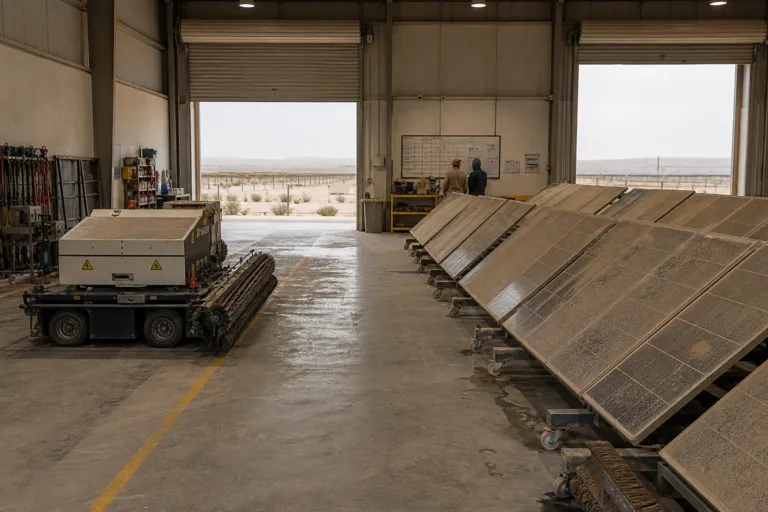
Because water use is a limiting factor, waterless and automated options are gaining attention. NOMADD’s dry-cleaning robot is described with 61% local content and a cost of USD 1.2 million per 100 MW. The same source notes it is 30% above manual crews, but it eliminates water use and cuts labor by 40%. Ecoppia’s waterless units are also being deployed, though capex is described as high for small commercial and industrial arrays. Beyond robotics, researchers at Imam Abdulrahman Bin Faisal University showed a concept that uses rear-side waste heat—routinely 60–80°C in desert conditions—to actuate shape memory alloy wires that mechanically dislodge dust, eliminating both water and external power consumption.
Heat management and soiling management intersect, because the same conditions that create dust events also drive high module temperatures. Typical crystalline silicon modules are cited with a temperature coefficient equivalent to roughly 0.3% to 0.45% efficiency loss for every degree Celsius above 25°C. That means a module operating at 65°C could see output decrease by 12% to 18%. These figures reinforce why desert-adapted engineering matters, including designs tailored for arid, high-temperature environments. Market reports also flag that desert installation engineering requires specialized mounting and soiling management protocols, and that these requirements can extend commissioning timelines compared with less harsh sites.
For operators, the practical question is not whether to address dust, but how to balance restoration, cost, and resource constraints. Water-jet washing can restore performance to 92% in KAUST’s Rubʽ al Khali measurement, but it still relies on water and on-site operations. Waterless robotics can remove water from the equation, and the NOMADD cost and labor figures provide a concrete planning reference at scale. Meanwhile, self-actuating concepts that convert module heat into motion suggest a path toward cleaning that does not add external energy demand. In Saudi Arabia’s high-irradiation context, desert-proof approaches help protect yield and bankability as the Kingdom builds toward its 2030 PV ambitions.
How severe can solar soiling losses be in Saudi Arabia’s desert conditions?
What does washing accomplish, based on Saudi measurements?
How do waterless robotic cleaners compare with manual crews?
How does heat compound the solar panel soiling challenge in Saudi Arabia?
What is a promising concept that avoids both water and external power for cleaning?
Talk to us for your needs in:
-
Energy Efficiency Strategy & Feasibility
-
Renewable Energy Strategy & Investment Advisory
-
Digital Energy & Smart Grid Strategy
-
Market Entry Strategy
-
Sustainability & Impact Strategy
-
Energy Project Governance & PMO Advisory
-
Energy Market Research
-
Energy Stakeholder & Customer Research
-
Energy Market Intelligence
-
Energy Feasibility & Investment Assessment
-
Energy Sector Benchmarking & Performance Strategy