Saudi Arabia’s AI and cloud buildout is accelerating, and water has become a design constraint, not an afterthought. Gulf states are arid and extremely hot, and the Middle East Council on Global Affairs argues the region cannot scale AI sustainably unless it treats water efficiency and summer peak resilience as first-order design constraints. Saudi-focused estimates underline why. Vision2030.ai reports Saudi data centers consumed an estimated 15 billion liters of water in 2024, citing an FTI Consulting assessment reported by Arab News. Separately, Mordor Intelligence’s study projects Saudi data center water consumption to reach 20.18 billion liters in 2025 and grow at a CAGR of 34.10% to 87.52 billion liters by 2030.
Heat and seasonality make the problem harder. The Middle East Council notes that in some Gulf regions, summer electricity consumption peaks can reach levels twice the winter peaks because air-conditioning demand soars. That is the same season when data centers face their greatest cooling challenge, and when traditional cooling methods struggle under extreme conditions. Fanack Water adds that many new data centers are rising across the Gulf in places where rainfall is minimal and summer temperatures soar above 40°C. In Saudi Arabia, this context shapes data center water usage: water is needed directly for cooling systems and indirectly through the power supply, because many power plants need water for cooling.
Liquid Cooling as a Water-Smart Pivot
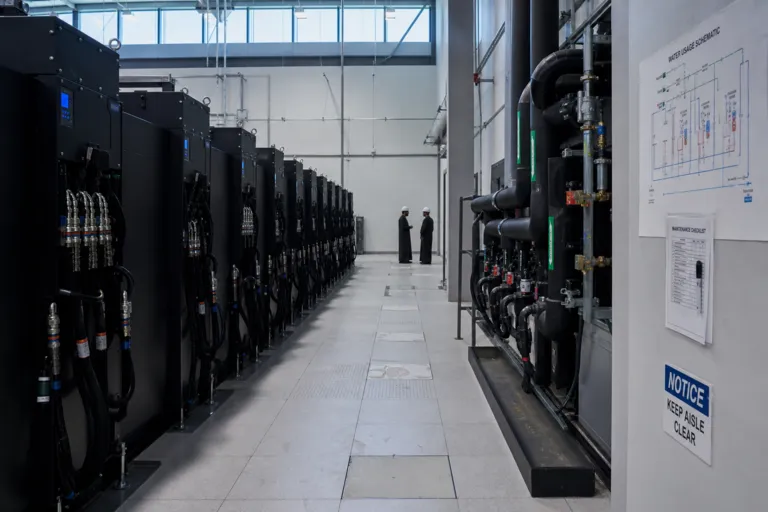
Liquid cooling is being positioned as a practical response to desert-climate constraints. Vision2030.ai reports that liquid cooling can reduce water consumption by up to 92% and cut energy 20–40% by removing chillers and server fans, with capital cost described as roughly equal to air cooling—$6.98 against $7.02 per watt. Market signals also point to rising adoption. MarketsandMarkets cites a Saudi Arabia data center liquid cooling market valuation of $48.6M in 2026. Mordor Intelligence’s Saudi Arabia data center construction report notes that cooling systems accounted for 41.30% of spending in 2025, and it describes liquid-cooling adoption accelerating as operators address desert-climate constraints.
The desalination link makes efficiency gains more valuable than they look on a site-level water meter. Fanack Water says many MENA countries depend heavily on desalination and gives Saudi Arabia’s municipal supply as nearly 70% desalinated; Vision2030.ai echoes that about 70% of Saudi drinking water comes from desalination and calls it one of the Kingdom’s most power-intensive processes. Fanack Water also estimates the region accounts for roughly 42% of global operational desalination capacity and warns that desalination is energy-intensive and can harm marine ecosystems through brine discharges. That means each added unit of cooling water can also increase energy demand, reinforcing the water–energy nexus that Gulf policy briefs urge regulators to address.
Policy and engineering choices are converging on “water-smart” defaults. The Middle East Council recommends mandating non-potable water use for all new data centers and implementing a dual water and energy efficiency standard. Vision2030.ai notes Saudi regulation directs developers toward low-water-intensity or closed-loop systems aligned with groundwater abstraction limits. On the technology side, Fanack Water says some large data centers in MENA use closed-loop systems and onsite treatment that recycle up to 96% of process water. In Saudi Arabia, Mordor Intelligence reports a September 2023 MoU between DataVolt and AquaTech Systems focused on collaboration in water cooling and recycling technologies and associated services—an example of how operators are operationalizing water efficiency as AI infrastructure expands.
What do current estimates suggest about Saudi Arabia’s data center water use growth?
How can liquid cooling affect water and energy needs in Saudi data centers?
Why is desalination central to the data center water usage discussion in Saudi Arabia?
What policy steps are proposed to make Gulf data centers more water-smart?
Talk to us for your needs in:
-
Energy Efficiency Strategy & Feasibility
-
Renewable Energy Strategy & Investment Advisory
-
Digital Energy & Smart Grid Strategy
-
Market Entry Strategy
-
Sustainability & Impact Strategy
-
Energy Project Governance & PMO Advisory
-
Energy Market Research
-
Energy Stakeholder & Customer Research
-
Energy Market Intelligence
-
Energy Feasibility & Investment Assessment
-
Energy Sector Benchmarking & Performance Strategy