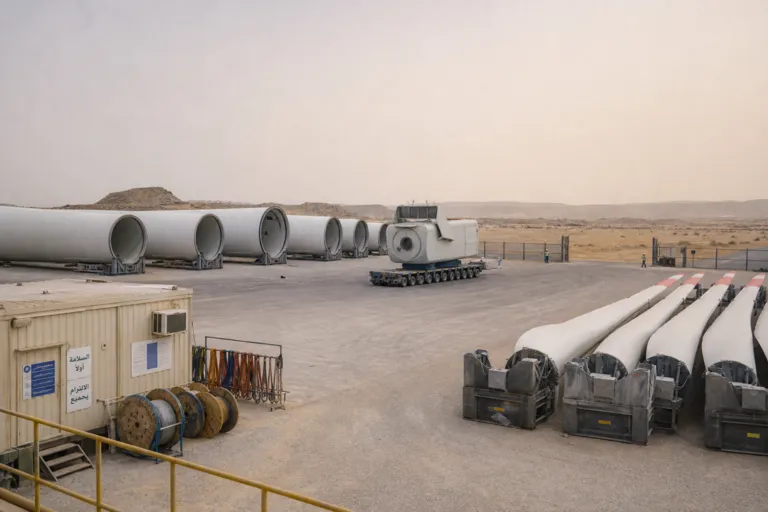
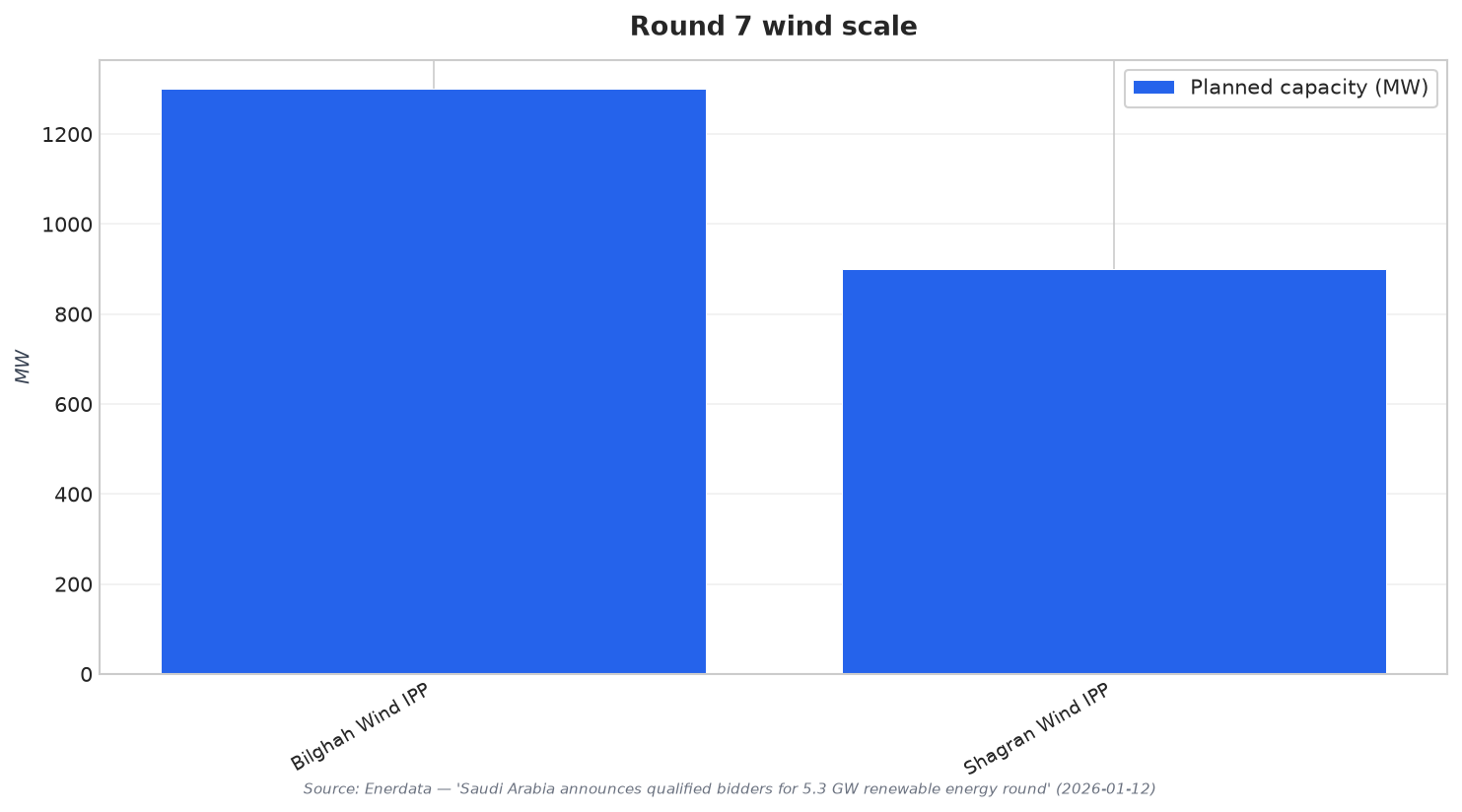
Saudi Arabia’s National Renewable Energy Program (NREP) Round 7 is a clear marker of intent for wind. The round totals 5.3 GW across solar PV and wind, and it is managed by the Saudi Power Procurement Company (SPPC). Within that, the wind portfolio is concentrated in the Madinah region and totals 2.2 GW, split between the 1.3 GW Bilghah Wind IPP and the 900 MW Shagran Wind IPP. Another source describes Round 7 as tendering over 5 GW and also lists Bilghah at 1,300 MW. This combination of large-scale capacity and standardized IPP structures is part of why the round matters for policy signal, financing confidence, and execution speed.
The qualified bidder line-up adds another layer to what Round 7 signals. For the solar PV projects, SPPC listed 22 qualified companies, including Masdar, EDF, Engie, Sembcorp Utilities, Jinko Power (HK), TotalEnergies Renewables, KEPCO, and SPIC Shanghai Electric Power Company, alongside local developers. For the wind IPPs, the qualified developers include a mix of international and local players such as Masdar, Alfanar Company, EDF, Engie, Marubeni Corporation, PowerChina, Sembcorp Utilities, and TotalEnergies Renewables. In practice, that breadth shows that Saudi Arabia’s wind procurement is being positioned as globally contestable, and that Round 7’s wind projects are being framed as mainstream infrastructure opportunities rather than niche pilots.
What Round 7 Suggests About Saudi Arabia’s Wind Build-Out
Round 7 also sits inside a wider planning narrative around pipelines and tracking. One analysis notes that, under Saudi Vision 2030, the Kingdom has set a target of 50% renewables by 2030, with a specific target of 16 GW of wind energy capacity. The same source says the KAPSARC renewables tracker improves transparency around auctions and pipelines, and that it shows Saudi Arabia has 12 wind projects that are either installed, under development, or tendered. Separately, a market outlook source states that the Saudi Arabia wind power market size reached USD 913.6 million in 2025, with expectations to reach USD 1,374.9 million by 2034, exhibiting a CAGR of 4.65% during 2026–2034. Together, these references frame Bilghah and Round 7 as part of a programmatic ramp, not a one-off award.
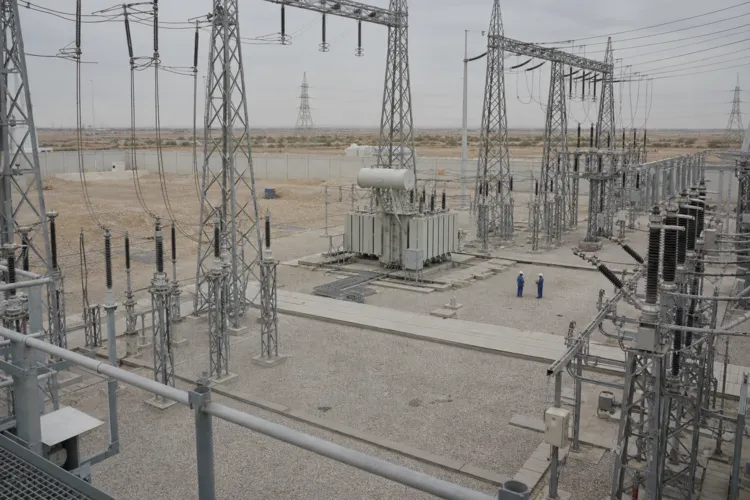
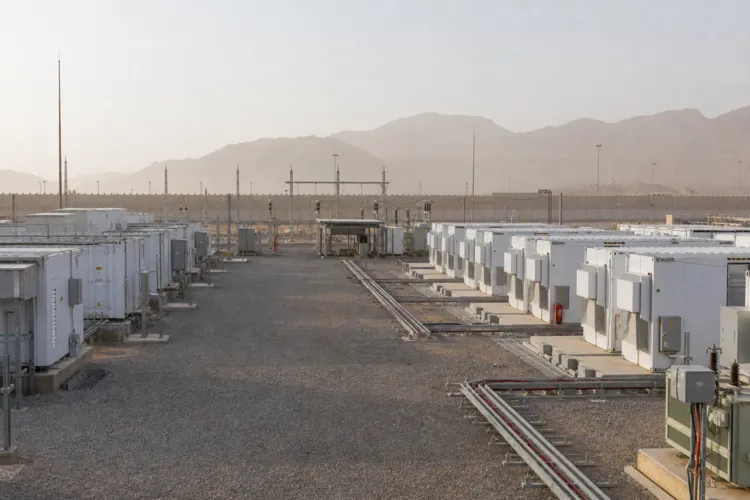
Execution, however, depends on grid readiness and integration choices. A market report points to planned USD 8–12 billion in grid upgrades and 1.1 GW of mandated storage in Round 7, with a 3–5-year rollout. It also highlights digital substations and demand-response programs as complements to hardware solutions. That context matters because Round 7 is not just about awarding capacity; it is also about ensuring that new wind and solar can connect and operate reliably. The same report notes that bids overshot tendered capacity by threefold in Round 6, suggesting strong developer appetite, but it also mentions USD 0.008–0.012/kWh in grid integration costs. Read together, the message is that Round 7’s scale is ambitious, and the enabling infrastructure is being treated as part of the investment story, not an afterthought.
For Bilghah specifically, the Round 7 design reinforces Saudi Arabia’s preference for large, bankable packages. A Saudi renewables guide describes projects typically structured as IPP agreements backed by 25-year PPAs with SPPC. In the same guide, Round 7 is described as the most aggressive yet, with plans to award approximately 14 GW of new renewable energy projects in 2026 through Round 7 tenders and parallel procurement tracks, while Bilghah (1,300 MW) and Shagran (900 MW) anchor the wind side. In that setting, the Bilghah Wind IPP in Saudi Arabia becomes more than a single project name; it becomes a signal of how the Kingdom intends to scale wind through repeatable tendering, deep bidder participation, and parallel work on the grid and flexibility needs.
What is the Bilghah Wind IPP in Saudi Arabia, and how large is it?
How much capacity is included in Saudi Arabia’s NREP Round 7 tender?
What other wind project is included alongside Bilghah in Round 7?
What does Round 7 indicate about grid and storage planning?
How is Saudi Arabia tracking and describing its wider wind pipeline?
Talk to us for your needs in:
-
Energy Efficiency Strategy & Feasibility
-
Renewable Energy Strategy & Investment Advisory
-
Digital Energy & Smart Grid Strategy
-
Market Entry Strategy
-
Sustainability & Impact Strategy
-
Energy Project Governance & PMO Advisory
-
Energy Market Research
-
Energy Stakeholder & Customer Research
-
Energy Market Intelligence
-
Energy Feasibility & Investment Assessment
-
Energy Sector Benchmarking & Performance Strategy