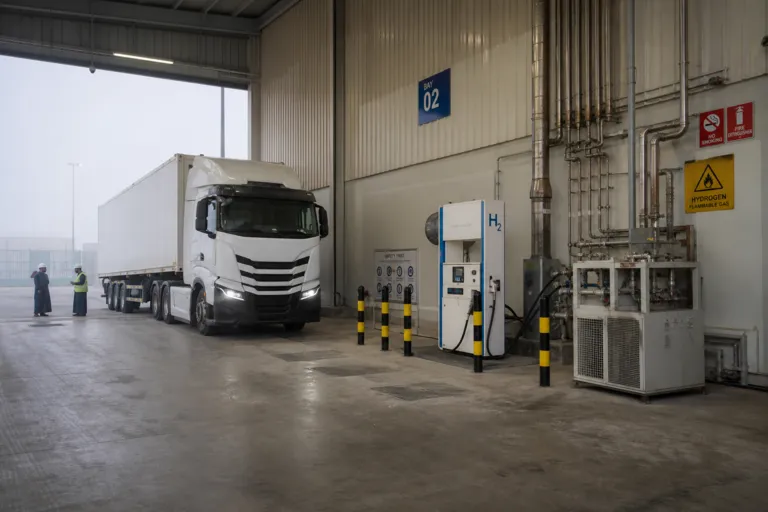
Hydrogen fuel cell trucks in Saudi Arabia are emerging as a serious tool for decarbonizing heavy freight logistics, especially where long-haul duty cycles make refueling time and operational flexibility critical. Industry commentary on heavy-duty trucks notes that hydrogen fuel cells are being utilized faster than alternative systems in freight because they offer shorter refueling time and longer range than battery-electric setups, making hydrogen attractive for long-haul delivery. In the Middle East, Saudi Arabia is cited among the countries leading demand for heavy-duty trucks, shaped by mega-projects and Vision 2030 initiatives such as NEOM, alongside early-stage interest in alternative fuels supported by sustainability goals and smart mobility initiatives.
On the demand side, Saudi Arabia’s hydrogen fuel cell vehicle (FCEV) market is projected to expand from a nascent base of fewer than 50 units in 2026 to an annual volume of about 3,500–5,000 units by 2035, with growth driven primarily by public transport and heavy-truck fleet mandates. The same outlook estimates a total addressable market value of USD 45–65 million in 2026, rising to USD 800 million–1.2 billion by 2035, implying roughly 35–40% CAGR. Government-led hydrogen mobility pilots under the Saudi Green Initiative and the NEOM hydrogen cluster are described as shifting from demonstration fleets to committed procurement, including plans for 200–400 FCEV buses for Jeddah and Riyadh by 2028.
What Will Make or Break Hydrogen Freight Rollouts
Infrastructure is the immediate gating factor for scaling hydrogen freight. Saudi Arabia is described as having only 3–5 hydrogen refueling stations operational in 2026, with a target of 25–30 stations by 2030, which limits early deployments mainly to depot-based fleet operations. Cost and operational economics are also moving targets. The total cost of ownership for heavy-duty FCEVs is described as narrowing versus battery-electric alternatives in long-haul applications, supported by falling fuel cell stack costs projected at USD 80–120/kW by 2030 and subsidized green hydrogen priced at USD 2.5–3.5/kg. These figures matter for logistics planning because fleets need predictable energy pricing and reliable access to refueling to keep trucks utilized.
Supply chain and capability gaps remain a practical constraint for hydrogen fuel cell trucks in Saudi Arabia. Import dependence is stated as exceeding 95% in 2026, with fuel cell stacks, high-pressure hydrogen tanks, and balance-of-plant components sourced from Japan, South Korea, Germany, and China, while localized assembly and maintenance are expected to emerge after 2030. The same outlook highlights bottlenecks in platinum catalyst sourcing and recycling, carbon fiber supply for high-pressure tanks, automotive-grade component validation, and manufacturing capacity for high-pressure valves and regulators. Lead times are described at 6–12 months, and workforce gaps in system integration, high-pressure safety certification, and diagnostics increase reliance on foreign technical support.
Service readiness will shape uptime and real-world economics as fleets expand. Annual aftermarket service contract values per heavy-duty FCEV are estimated at USD 8,000–15,000 for stack refurbishment and high-pressure system certification, indicating a growing service layer alongside vehicle procurement. Globally, broader market signals reinforce why heavy freight is a focal use case: one global report values the hydrogen fuel cell vehicle market at USD 3.87 billion in 2025, with Asia Pacific holding 49.80% share in 2025, while another notes hydrogen trucks are becoming practical for decarbonizing heavy-duty transport due to long range, fast refueling, and high payload capacity. For Saudi Arabia, the near-term story is less about mass adoption everywhere and more about building corridor and depot coverage, local skills, and dependable parts flows to convert mandates and pilots into repeatable logistics operations.
What is the outlook for hydrogen fuel cell truck adoption in Saudi Arabia?
How many hydrogen refueling stations are operating in Saudi Arabia, and what is the target?
What cost signals could improve the business case for fuel cell heavy trucks?
How dependent is Saudi Arabia on imported fuel cell truck components today?
What does ongoing maintenance look like for heavy-duty FCEVs?
Talk to us for your needs in:
-
Energy Efficiency Strategy & Feasibility
-
Renewable Energy Strategy & Investment Advisory
-
Digital Energy & Smart Grid Strategy
-
Market Entry Strategy
-
Sustainability & Impact Strategy
-
Energy Project Governance & PMO Advisory
-
Energy Market Research
-
Energy Stakeholder & Customer Research
-
Energy Market Intelligence
-
Energy Feasibility & Investment Assessment
-
Energy Sector Benchmarking & Performance Strategy