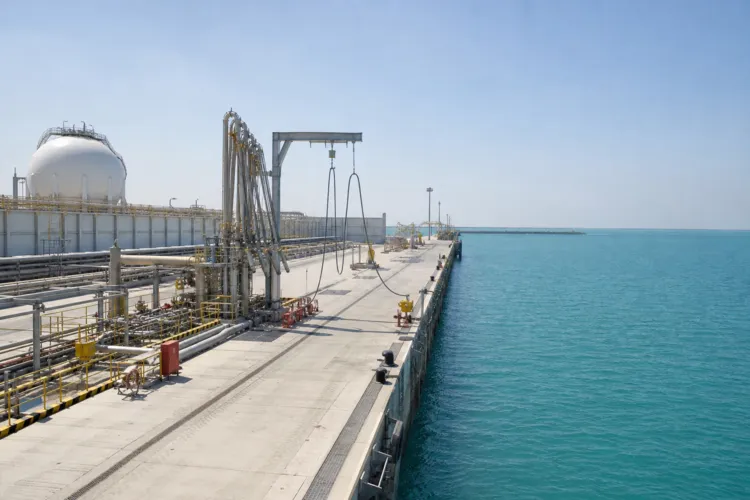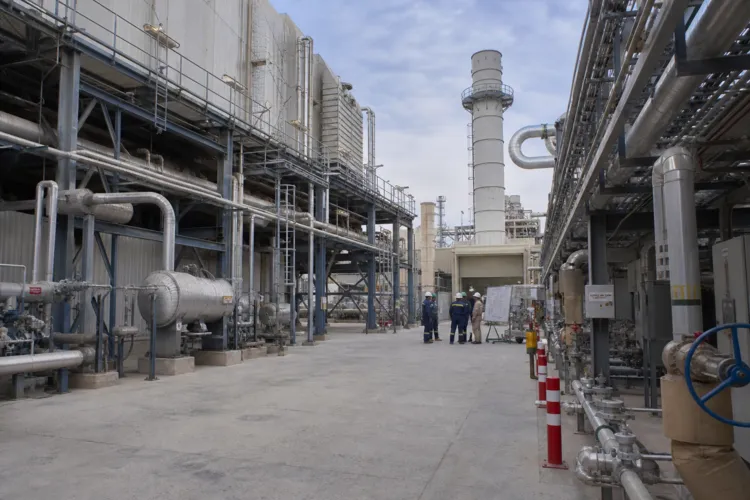
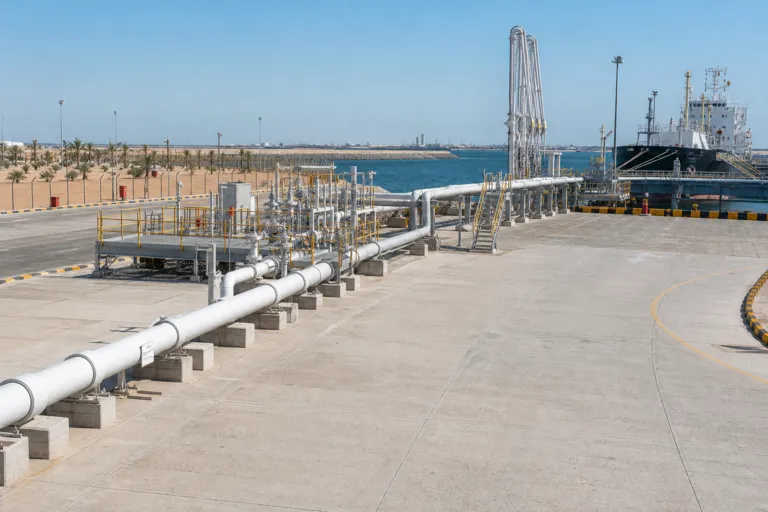
Hydrogen pipeline infrastructure in Saudi Arabia is increasingly discussed as a practical connector between centralized production hubs and export ports. Global Market Insights notes that countries such as the UAE, Saudi Arabia, and Oman are investing in pipelines that connect hydrogen production sites to ports and shipping terminals, specifically to facilitate hydrogen exports. That export-first logic is also reflected in broader market growth expectations: the hydrogen pipeline market was valued at more than USD 154.7 million in 2024 and is expected to grow from USD 5.1 billion in 2025 to USD 27.2 billion by 2035. In parallel, SNS Insider estimates the hydrogen pipeline market at USD 9.25 billion in 2023, projecting USD 35.43 billion by 2032 at a 16.09% CAGR.
At the project level, Saudi pipeline planning is being shaped by export infrastructure needs that extend beyond the pipe itself. Fortune Business Insights reports that in May 2024, Air Products, ACWA Power, and NEOM continued major investment and project execution agreements for the NEOM Green Hydrogen Project in Saudi Arabia, supporting large-scale hydrogen production, storage, and ammonia export infrastructure development. A separate Global Market Insights materials-focused report describes NEOM as the highest-profile single-project hydrogen pipeline infrastructure development outside of Europe, requiring hydrogen-grade materials across electrolyzer evacuation, liquefaction feed, and export terminal connection applications. This framing ties pipelines directly to the port-side system that makes exportable molecules possible, not just to domestic distribution.
Design Choices: Dedicated Lines, Repurposed Gas Networks, and Hub-to-Port Links
Three design themes recur across the sources: dedicated hydrogen pipelines, repurposing existing natural gas pipelines, and hub-and-spoke layouts that concentrate production then move volumes toward end users and terminals. Global Market Insights highlights integration and repurposing of existing natural gas pipelines for hydrogen transportation, describing it as a way to leverage prevailing infrastructure. Fortune Business Insights similarly says existing natural gas pipeline networks are increasingly being evaluated for hydrogen repurposing to reduce infrastructure development costs and accelerate deployment timelines. At the network level, Global Market Insights points to a hub-and-spoke model in which centralized hydrogen production hubs connect to multiple end users through dedicated pipelines, a structure that can logically extend to export terminals when ports become the “end user” for outbound flows.
Export readiness also depends on port logistics and handling systems, which creates a strong coupling between pipelines and terminals. Mobility Foresights describes a Saudi trend toward dedicated export infrastructure, including hydrogen terminals, storage facilities, and carrier systems. It adds that investment in hydrogen-ready ports, bunkering systems, and cold-chain logistics is enabling large-scale export flows, while technologies such as ammonia conversion, LOHC, and cryogenic liquid hydrogen carriers are being piloted to support efficient transport. The same source notes that infrastructure expansion for hydrogen carriers, pipelines, and port handling facilities is enabling cross-border trade flows, and that strategic partnerships with global trading hubs are strengthening export corridors. Fortune Business Insights also flags rapid development of hydrogen import/export terminals and port-based hydrogen hubs, naming Saudi Arabia among countries investing in ammonia and liquid hydrogen export facilities to supply hydrogen-importing economies including Japan, South Korea, and Germany.
Saudi Arabia’s pipeline buildout is also discussed in the context of established energy infrastructure and adjacent programs. The Global Market Insights pipeline materials report says Saudi Aramco’s parallel blue hydrogen and ammonia export programs leverage the country’s established hydrocarbon production infrastructure and carbon capture investment programs, shaping demand for qualified pipeline materials and procurement practices carried over from the oil and gas sector. IndexBox adds that retrofitting existing pipelines for hydrogen service with material upgrades is a major trend, alongside dedicated hydrogen pipelines for industrial clusters and hubs. Taken together, the sources describe a pragmatic pathway: connect production hubs to ports with a mix of dedicated hydrogen lines and upgraded legacy corridors, while aligning pipeline routing to storage, ammonia export systems, and port handling capacity.
What is driving hydrogen pipeline infrastructure development in Saudi Arabia toward export ports?
Which Saudi project is highlighted as a major pipeline-linked hydrogen development?
Are existing natural gas pipelines being considered for hydrogen transport?
What export logistics systems are mentioned alongside pipelines in Saudi Arabia?
Talk to us for your needs in:
-
Energy Efficiency Strategy & Feasibility
-
Renewable Energy Strategy & Investment Advisory
-
Digital Energy & Smart Grid Strategy
-
Market Entry Strategy
-
Sustainability & Impact Strategy
-
Energy Project Governance & PMO Advisory
-
Energy Market Research
-
Energy Stakeholder & Customer Research
-
Energy Market Intelligence
-
Energy Feasibility & Investment Assessment
-
Energy Sector Benchmarking & Performance Strategy